

arches, circles and softened media-wall geometry: what to compare before choosing a favourite
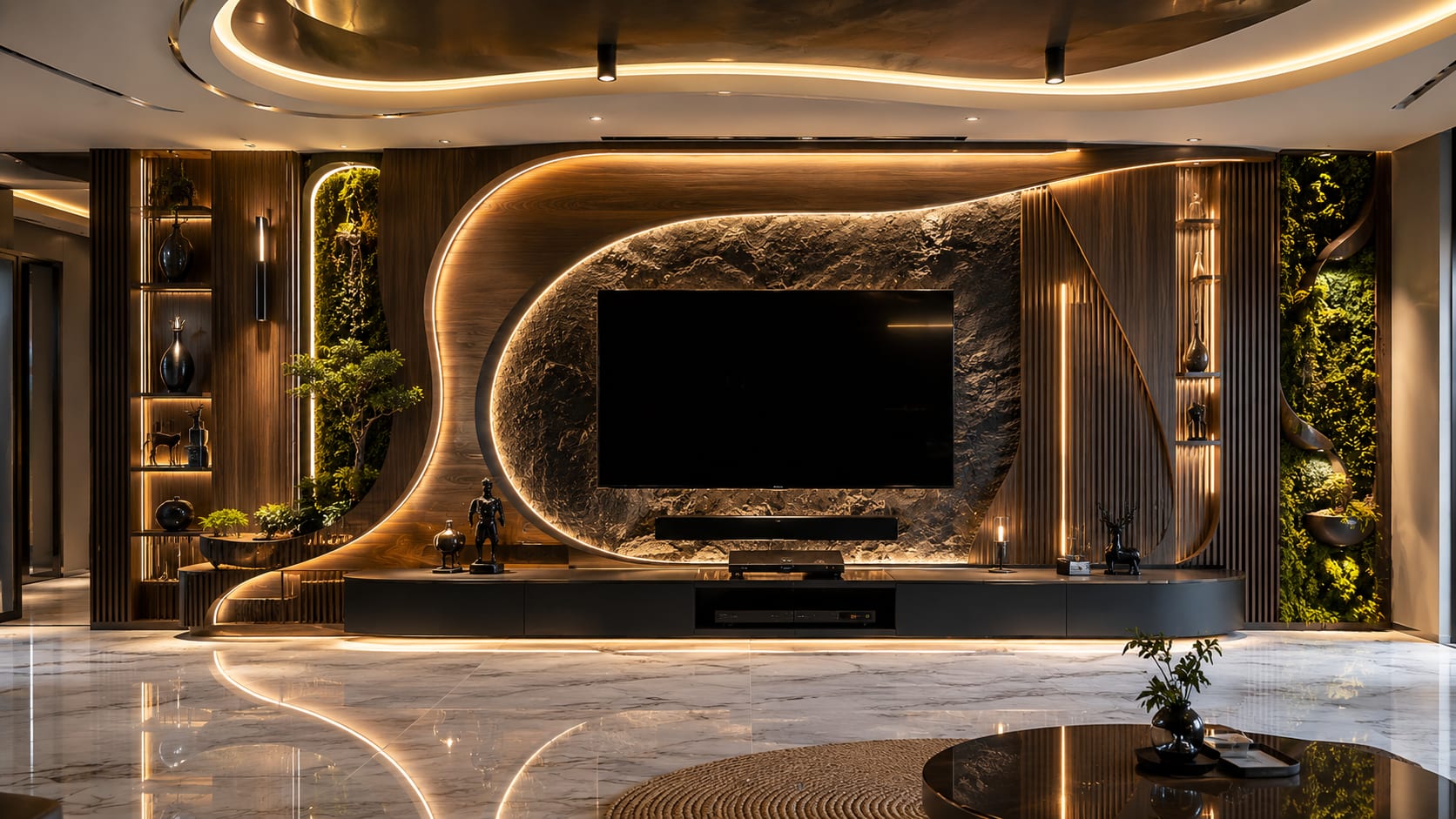
Use "An Organic Curved Walnut TV Wall with Stone and Moss" as a scale check. Identify the dominant surface, the secondary material and the lighting that connects them. If your room cannot preserve that hierarchy, simplify the idea before choosing finishes.
7 rooms, each with its own design decision
A Curved Backlit TV Wall with a Linear Fireplace
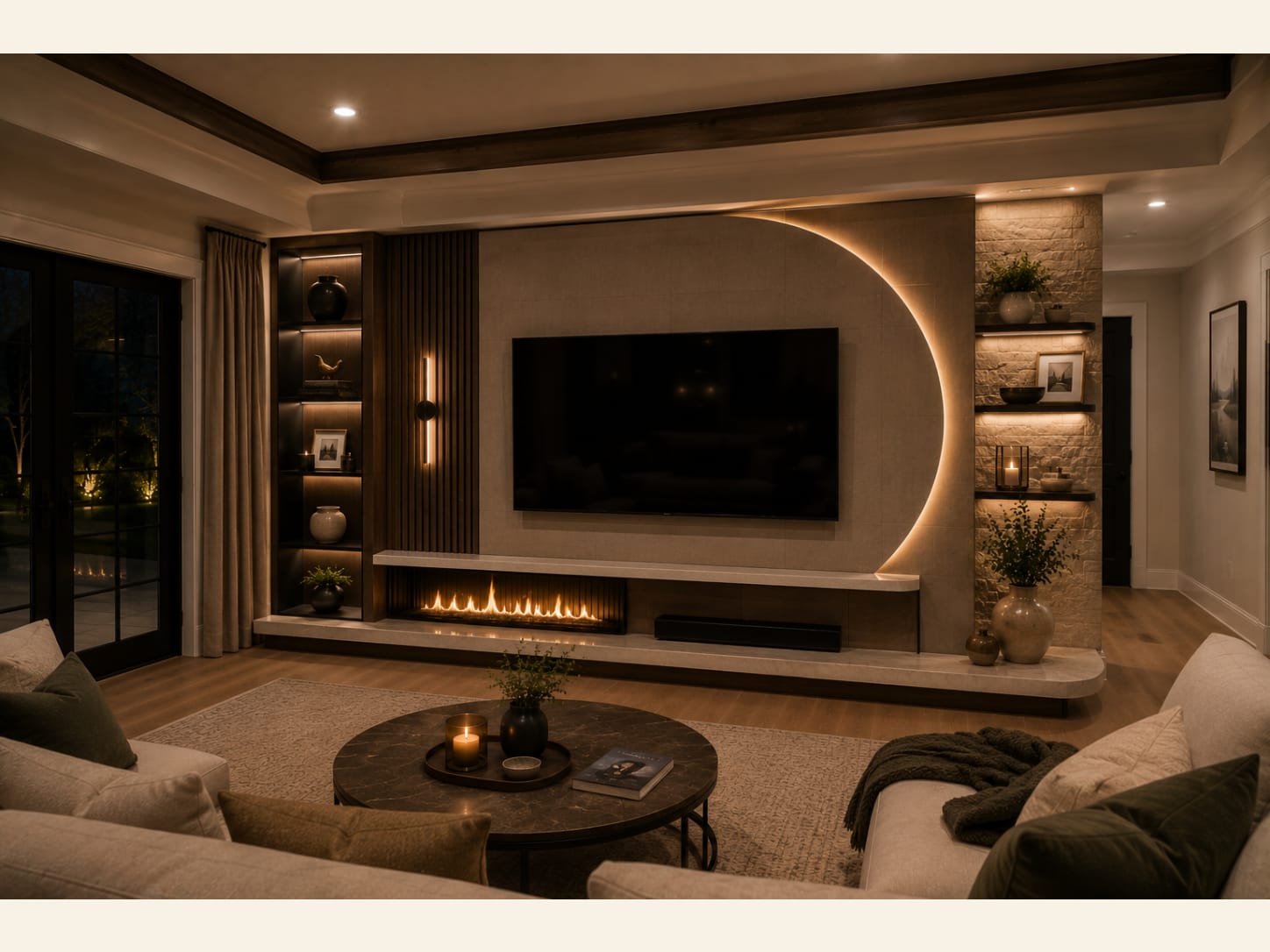
A warm media room with a curved backlit tile TV wall, a linear fireplace, a stacked-stone column, fluted wood, lit shelving and cream sofas around a marble coffee table. The curved backlit arc is the whole idea: an LED glow traces a big soft curve around the screen so the wall reads as a lit shape, not a black rectangle. A linear fireplace runs along the base for a second layer of glow, and the wall is flanked by fluted wood on one side and a stacked-stone column on the other for texture. Lit shelving and a low stone hearth ground it, and the screen sits on a matte tiled panel so it doesn't reflect the room. Key details: Trace a big soft curve of hidden LED behind the panel so the wall glows as a shape. ; Put the TV on a matte, mid-tone panel, glossy or heavily veined behind a screen reflects and competes. ; Add a linear fireplace below for a warm second light source. ; Flank the wall with two different textures (fluted wood, stone) so it's not one flat surface. ; Recess and light the shelving rather than sitting objects on an open ledge.. The strongly shaped, of-the-moment forms do age faster than a plain panel, that's the honest trade-off with any statement feature. What ages best is texture over shape: the stone column and fluted wood here would still look intentional in ten years, whereas a bold curve is more tied to now.
A White Sculpted Curve TV Wall with Moss and Stone

Flowing white plaster curves frame a rough white stone panel threaded with living moss, set between light oak fluting, lit display niches and a perforated glowing screen. In a pale scheme, edges do the work that contrast usually does. The white curves are thick and rounded, so the warm LED tucked behind them throws a soft gradient down the plaster, the shape is legible without a single dark tone. Behind them sits the surprise: a rough pale stone panel with moss threaded through it, which gives the wall its texture and its life. Because both the stone and the plaster sit in the same off-white family, the moss green becomes the only real colour in the composition and lands much harder than it would against dark stone. The light oak fluting and the perforated glowing screen on the right add rhythm without weight, and the console is pale oak so nothing anchors the wall down. Key details: Sculpted white plaster curves, thick rounded forms with concealed LED behind the edges; Moss-threaded stone panel, rough pale stone with preserved moss set into the crevices; Light oak fluting, slim vertical battens framing the composition on both sides; Lit display niches, recessed shelves with warm strips for sculptural objects; Perforated glowing screen, a decorative oval-cut panel backlit to read as a lantern; Pale oak floating console, a wall-hung unit with a ribbed centre and cove lighting. Practical moves: Build the curves in shaped MDF and finish in a smooth lime plaster or microcement.
A Warm Minimal Plaster TV Wall with an Arched LED Reveal

A soft plaster wall with a rounded arch of concealed light framing the screen, paired with light oak shelving, trailing plants and a handleless white console that floats. It succeeds by subtraction. The whole feature is one rounded arch reveal, a shallow recess in the plaster with LED hidden along its inner edge, and because it is the only gesture on the wall, it reads as deliberate rather than decorative. The microcement or lime plaster finish gives a soft, slightly mottled surface that catches light very differently from flat paint; that texture is doing quiet work all day. The light oak shelving on the right breaks the width and gives the plants somewhere to trail from, which stops the minimalism from feeling clinical. Everything else is handleless and wall-hung, so the floor stays clear and the room reads bigger. This is the cheapest wall in the collection to build and arguably the easiest to live with. Key details: Arched LED reveal, a rounded recess in the plaster with concealed warm lighting; Microcement plaster finish, a soft, subtly mottled wall surface instead of flat paint; Light oak lit shelving, open display columns with warm strips and trailing greenery; Handleless white console, a wall-hung push-to-open unit with under-cove lighting; Oak cabinet with arched niche, a tall storage unit repeating the arch motif; Slatted oak column, a narrow fluted panel softening the transition to the side wall. Practical moves: Form the arch as a shallow recess in the plasterboard, then plaster over it for a seamless edge.
An Organic Curved Walnut TV Wall with Stone and Moss

A teardrop curve of walnut wraps a rough natural stone panel behind the screen, flanked by preserved moss walls, fluted timber and lit niches under a sculpted bronze ceiling. Three textures do all the work: rough split-face stone, smooth curved walnut and soft preserved moss. Because the stone is genuinely textured, the raking LED along the curve catches every ridge, giving the wall depth that a flat panel could never fake. The walnut curve is the mediator, it softens the hard stone edge and carries the eye around the composition rather than stopping at a corner. The moss panels are the surprise: they add colour and a sense of life without a single pot to water, and their matte, absorbent surface quietens the room acoustically. Underneath, the console is a plain dark box on purpose, because with this much texture above, any more detail would tip into clutter. Key details: Rough natural stone panel, split-face stone cladding directly behind the screen; Curved walnut surround, a smooth teardrop form wrapping the stone and carrying the LED; Preserved moss walls, framed green panels either side, no watering or light needed; Fluted timber columns, vertical grooved wood grounding the composition at each end; Lit display niches, slim timber recesses with warm concealed strips; Sculpted bronze ceiling raft, a curved mirrored-bronze ceiling form echoing the wall below. Practical moves: Use real split-face stone or a good stone-veneer panel, smooth tile loses the whole effect. ; Graze the stone with LED from the curve edge, not head-on, so the texture casts shadows.
A Bright Cream Curved TV Wall with Gold LED and Oak

A flowing cream marble curve traced in warm gold light, with a curved oak fluted panel, gold-trimmed lit shelves and a white gloss console, luxury without the darkness. Light schemes usually lose sculptural drama because pale surfaces flatten out. The fix here is shadow, not contrast: the curve is deep enough that the warm LED grazing its edge throws a genuine shadow line across the cream stone, and that shadow is what defines the shape. The oak fluted panel is the second smart move, wrapped around the corner in a soft curve, it stops the wall ending abruptly and brings in a warmer, more tactile tone against all that stone. The console is white gloss and wall-hung, so it visually disappears and lets the curve sweep uninterrupted. The gold is used sparingly: a shelf trim, a small circular detail, the LED itself. Any more and the room would tip into the heavy glam look this is deliberately avoiding. Key details: Cream marble curve, a flowing S-shaped stone panel wrapping the screen; Warm gold LED line, a continuous strip tracing the full curve edge; Curved oak fluted panel, ribbed timber bent around the corner to close the composition; Gold-trimmed lit shelves, slim display niches with brass edging and concealed strips; White gloss floating console, a wall-hung unit with cove lighting beneath; Layered cove ceiling, a shaped ceiling reveal repeating the curve overhead. Practical moves: Make the curve deep enough to cast a shadow, a shallow curve vanishes in a pale scheme.
A Curved Backlit Marble TV Wall with a Statuario Arc

A sweeping backlit arc cut into statuario marble frames the screen, with dark fluted panelling, tall lit display towers and a marble console raised on a glowing stepped plinth. The arc is cut, not applied. A recessed LED channel follows the curved edge of the marble, so the light appears to come from behind the stone rather than from a strip stuck on top, that is the difference between looking bespoke and looking like a DIY add-on. Statuario is the right stone for it: bold grey veining on a bright white ground has enough drama to survive being lit. Either side, tall lit towers hold the wall's height and give the arc something vertical to push against, and the console sits on a lit stepped plinth, which raises the whole unit and stops the marble from meeting the floor awkwardly. Note how restrained the styling is, a handful of glass objects, nothing that competes. Key details: Curved backlit arc, a large sweeping LED-lined curve carved into the marble face; Statuario marble panel, bright white stone with strong grey veining behind the screen; Dark fluted panelling, vertical grooved timber framing the stone on both sides; Tall lit display towers, slim floor-to-ceiling niches, one backed in dark marble; Marble floating console, a stone-clad media unit matching the wall panel; Lit stepped plinth, a raised base with concealed LED that lifts the console visually. Practical moves: Draw the arc large, a shy curve looks like a mistake; it should read from across the room.
A Curved Wave TV Wall with Blue and Gold LED Lighting

Sweeping wave-shaped textured stone forms this futuristic media wall, outlined in twin blue and warm-gold LED lines, with shelves carved into the curves and a fibre-optic star ceiling above. The reason it does not tip into gimmick is that the curves are structural, not decorative. The wave shapes actually form the shelving, flat ledges emerge where the curve flattens out, so the storage is carved from the geometry rather than bolted on. The textured stone finish is important too: a matte, slightly rough surface catches the raking LED light and reveals the sculpting, where a polished surface would just glare. Using two light colours is the risky move, and it is handled by keeping them separated: the warm gold traces the upper curve, the cool blue the lower one, so they never sit side by side competing. The screen is set into the darkest, flattest part of the composition, which is what keeps it watchable rather than lost in the swirl. Key details: Sculpted wave panels, large S-curved forms in textured grey stone-effect finish; Twin LED outlines, a warm gold line tracing one curve, cool blue tracing the other; Shelves carved into the curves, ledges formed where the wave flattens, lit from within; Fibre-optic star ceiling, pinpoint lights scattered across a dark recessed ceiling; Dark fluted side panels, vertical grooved timber grounding each end of the composition; Low floating console, a simple dark media unit that stays out of the sculpture's way. Practical moves: Build the waves in shaped MDF or GRG, then finish in textured microcement, not real stone.
What to verify before recreating the look
For curved tv wall design ideas, the practical decisions have to support arches, circles and softened media-wall geometry. Plan screen height, viewing distance, ventilation, sockets, data points and speaker locations before building the decorative wall. Keep service panels and drivers accessible, use diffusers over LED strips and confirm the wall can support the television and any stone or cabinetry. Highly polished surfaces can reflect the screen and windows, so inspect samples from the actual seating position. Conceal cables through a compliant route rather than trapping adapters inside an unventilated void.
How to edit these curved tv wall design ideas for a real room
Use “A Curved Backlit TV Wall with a Linear Fireplace” and “A Curved Wave TV Wall with Blue and Gold LED Lighting” as two boundaries rather than a shopping list: identify which end better matches your room's scale, then keep the strongest idea connected to arches, circles and softened media-wall geometry. Resolve screen height, viewing distance, ventilation, cable access and reflected glare before adding decorative layers. The finished space should preserve the useful relationship you noticed in the reference while leaving room for the objects, habits and maintenance needs that make it yours.
Join the conversation
Share your thoughts on this room