

charcoal, navy and black with controlled lighting: what to compare before choosing a favourite
Look at "A Backlit Cream Marble TV Wall with Timber and Charcoal" after the first two examples and ask what it removes as well as what it adds. A convincing scheme usually repeats a short material palette and lets one idea lead instead of giving every surface equal emphasis.
7 rooms, each with its own design decision
A Navy Built-In Media Wall with Lit Shelving and Brass Lights

Navy painted joinery frames the TV in a panelled recess, with lit display shelving either side, brass picture lights, a stone counter and closed cabinets running the full width. The screen sits in a panelled recess rather than flat on the joinery, so it reads as part of the cabinetry instead of a black rectangle stuck to it. Either side, lit shelving with brass picture lights above does the same job a marble panel would, it gives the wall presence, but adds display space at the same time. The stone counter running the full width is the detail that lifts it: it breaks the navy mass horizontally and gives a surface for candles and lamps. Underneath, closed cabinets across the entire span handle everything a family room accumulates, which is precisely what most stone media walls cannot do. Key details: Navy painted joinery, full-width built-in matching the kitchen cabinet colour; Panelled TV recess, the screen set into the cabinetry rather than mounted on it; Lit display shelving, warm strips under each shelf either side of the TV; Brass picture lights, traditional fittings mounted above each shelving column; Stone counter, a pale worktop breaking the navy horizontally; Full-width closed cabinets, deep drawers and doors below the counter. Practical moves: Recess the TV into a panelled back so it reads as joinery, not an appliance. ; Run a stone or timber counter across the full width to break up a tall painted wall. ; Light shelves individually and add hard-wired picture lights above for a layered effect.
A Navy Built-In Media Wall with Brass Picture Lights

Classic shaker cabinetry painted deep navy, symmetrical lit shelving, brass picture lights and a pale stone counter running the full width, a traditional built-in rather than a slab wall. Modern slab walls can look wrong in a period or traditionally detailed room, and this design solves that by treating the TV as part of a proper built-in. The deep navy paint is dark enough that the screen recedes into it when off, which is the same trick the marble walls use, achieved with a tin of paint instead. Symmetrical open shelving flanks the centre with warm strips hidden under each shelf, while brass picture lights mounted on the top rail add a genuinely traditional gesture and throw light down the display. Underneath, shaker drawers and cupboards give the closed storage that most modern media walls quietly lack. The pale stone counter running the full width breaks the navy mass and gives the whole thing a furniture-like solidity. Key details: Deep navy shaker cabinetry, painted framed doors and drawers with slim brass bar pulls; Symmetrical lit shelving, matching open display columns with warm under-shelf strips; Brass picture lights, traditional swing-arm lights fixed to the top rail of each column; Pale stone counter, a full-width worktop separating upper shelving from lower storage; Panelled TV recess, a beadboard-style back panel setting the screen into the joinery; Closed base storage, deep drawers and cupboards for everything that should not be seen. Practical moves: Choose a deep, slightly muted navy, a bright blue will fight the room instead of receding.
A Walnut and Charcoal Concrete TV Wall with a Lit Column

A matte charcoal concrete panel sits behind the screen, wrapped in rich walnut panelling, with a tall lit display column, a fluted console and a bright strip washing the floor. Matte concrete is the ideal backdrop for a screen. It has almost no reflectivity, so lamps and windows do not bounce back at you during viewing, and its subtle cloudy texture keeps it from looking like flat grey paint. Because that panel is deliberately plain, the walnut can be rich, a broad band of horizontal-grain timber above the screen, a tall column of lit display shelving to the left, and a long console below with a fluted centre section. The lit column is the anchor: it gives the wall a vertical accent that stops the composition reading as one long horizontal band. Finally, the LED under the console is set low and bright enough to wash across the floor, which lifts the whole unit and makes the room feel wider at night. Key details: Matte charcoal concrete panel, microcement or concrete-effect finish directly behind the TV; Rich walnut panelling, a horizontal-grain timber band running above the screen; Tall lit display column, a full-height walnut shelving tower with warm strips; Fluted console centre, a ribbed section breaking up the long media unit; Floor-washing LED, a bright warm strip under the console spilling onto the floor; Oak slat screen, a vertical batten panel closing the composition to the right. Practical moves: Use microcement or a concrete-effect coating rather than grey paint, the texture is the point.
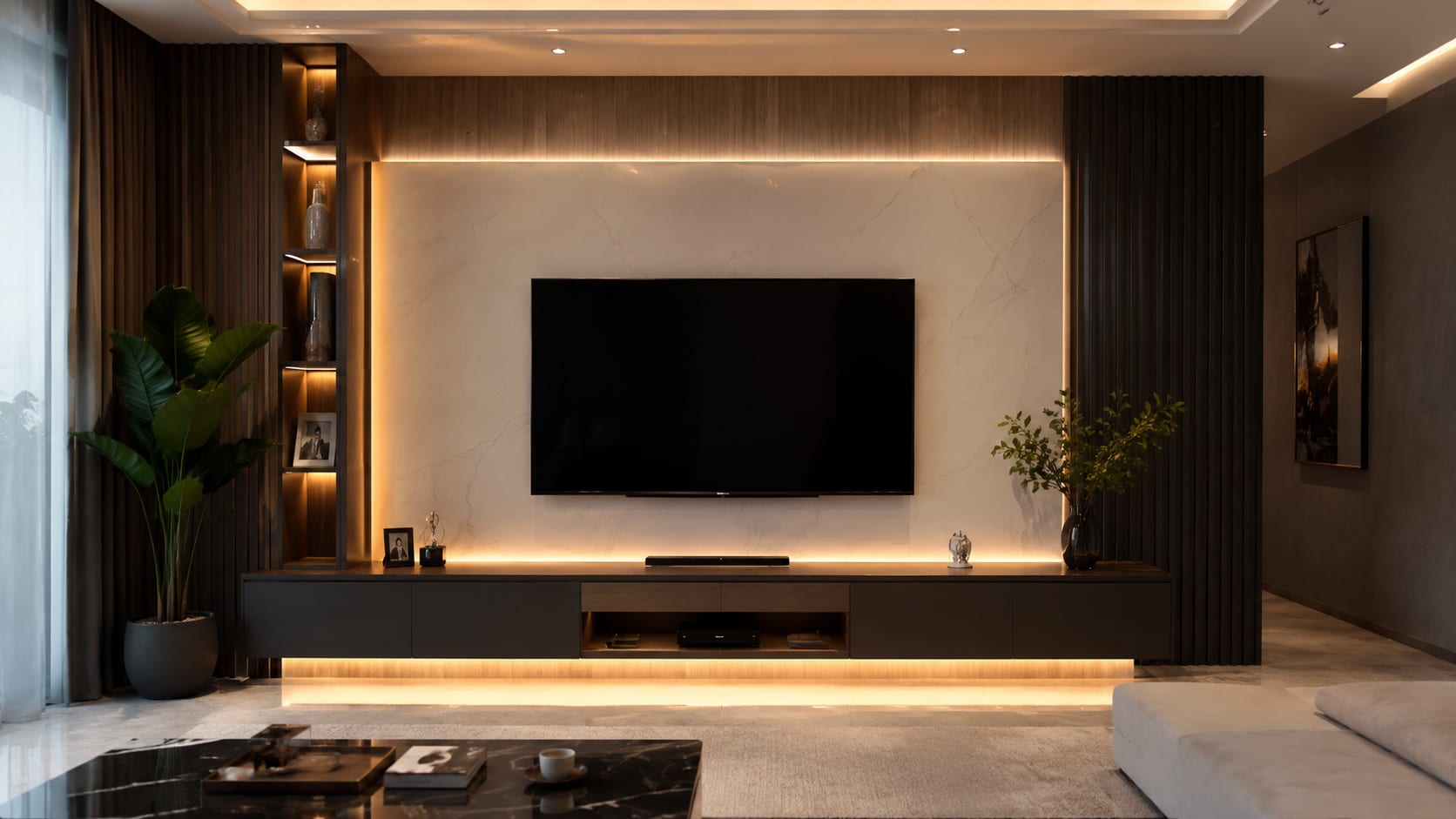
A Backlit Cream Marble TV Wall with Timber and Charcoal

A large cream marble panel outlined by a continuous warm LED reveal, set under warm timber panelling and beside charcoal fluting, with a dark console glowing from beneath. The whole design rests on one detail: the LED reveal runs continuously around all four sides of the marble panel. That unbroken rectangle of light separates the stone from the wall and makes it read as a floating plane rather than cladding. Because the marble itself is pale with quiet veining, it never fights the screen, an important point that busier stone often gets wrong. Above it, warm timber panelling stops the wall going cold, and to the right a charcoal fluted panel provides the dark anchor that gives the composition weight. The console is dark and wall-hung with a strong cove beneath, so the eye reads two glowing lines, one around the stone, one under the unit, and nothing else competes. Key details: Cream marble panel, a large, quietly veined stone plane centred behind the screen; Continuous LED reveal, warm light running around all four edges of the panel; Warm timber panelling, horizontal-grained wood above the stone, softening the palette; Charcoal fluted panel, a dark ribbed section anchoring the right-hand side; Slim lit display column, a narrow shelving tower with warm strips on the left; Floating dark console, a wall-hung media unit with a strong glow beneath. Practical moves: Choose a stone with soft, low-contrast veining so it never competes with the screen.
A Dark Marble TV Wall with Gold Seams and Backlit Edges

Large dark grey-brown marble panels are joined by slim gold seam lines and lit from behind their edges, framed by black fluting and a lit display tower. Large stone walls always have joints. Most designers spend money trying to make them vanish; here they are celebrated as gold seams, which does two useful things. It divides a very large dark surface into readable proportions, and it adds precious-metal detail without a single applied ornament. The stone is a dark grey-brown with warm veining, so the room stays warm rather than going cold-grey, and the edges are backlit rather than the whole panel, a subtler move that outlines the stone and leaves the centre properly dark for viewing. Black fluting on the right and a lit display tower on the left frame the composition asymmetrically, which stops it feeling like a showroom set. The console keeps taupe drawer fronts, a small warm note that softens all the black. Key details: Dark grey-brown marble panels, large-format stone with warm veining behind the screen; Gold seam lines, deliberately widened joints filled with slim brass or gold profile; Backlit panel edges, warm LED behind the stone perimeter, leaving the centre dark; Black fluted panel, a vertical ribbed section closing the right-hand end; Lit display tower, a tall black shelving unit with warm strips on the left; Two-tone console, a dark unit with taupe drawer fronts for warmth. Practical moves: Plan the panel layout first so the gold seams land at proportions you actually want.
A Dark Luxe Grey Marble TV Wall with Gold Vein Inlay

A wide, low-lit media wall in smoky grey marble with a gold vein inlay line, black fluted panelling, brass-framed display boxes and a long fluted console that glows from beneath. Dark rooms fail when they go flat. Here the darkness is built from three different textures, smoky grey marble, black vertical fluting and dark timber joinery, so the eye always has something to catch even at low light. The gold inlay line is the masterstroke: a single brass strip set into the stone, following the natural direction of the veining, which makes an expensive slab look intentional rather than random. Brass-framed display boxes punctuate the fluting at different heights so the wall does not read as one long band, and the console glows from underneath, lifting the whole mass off the floor. Crucially, the TV is almost invisible when off, because a black screen on dark stone simply disappears. Key details: Smoky grey marble slab, warm-grey stone with soft white and gold veining behind the screen; Gold vein inlay, a slim brass strip inset diagonally to echo the natural vein direction; Black fluted panelling, narrow vertical battens running the full height either side; Brass-framed lit niches, slim metal-edged display boxes with warm concealed lighting; Long fluted console, a floor-to-wall media unit with a dark stone top and cove lighting; Halo ring pendant, a brass circular light that repeats the gold accent overhead. Practical moves: Pick a grey stone with real movement, flat grey will look dull once the lights are down.
A Maroon and Gold Marble TV Feature Wall With Backlit Shelves
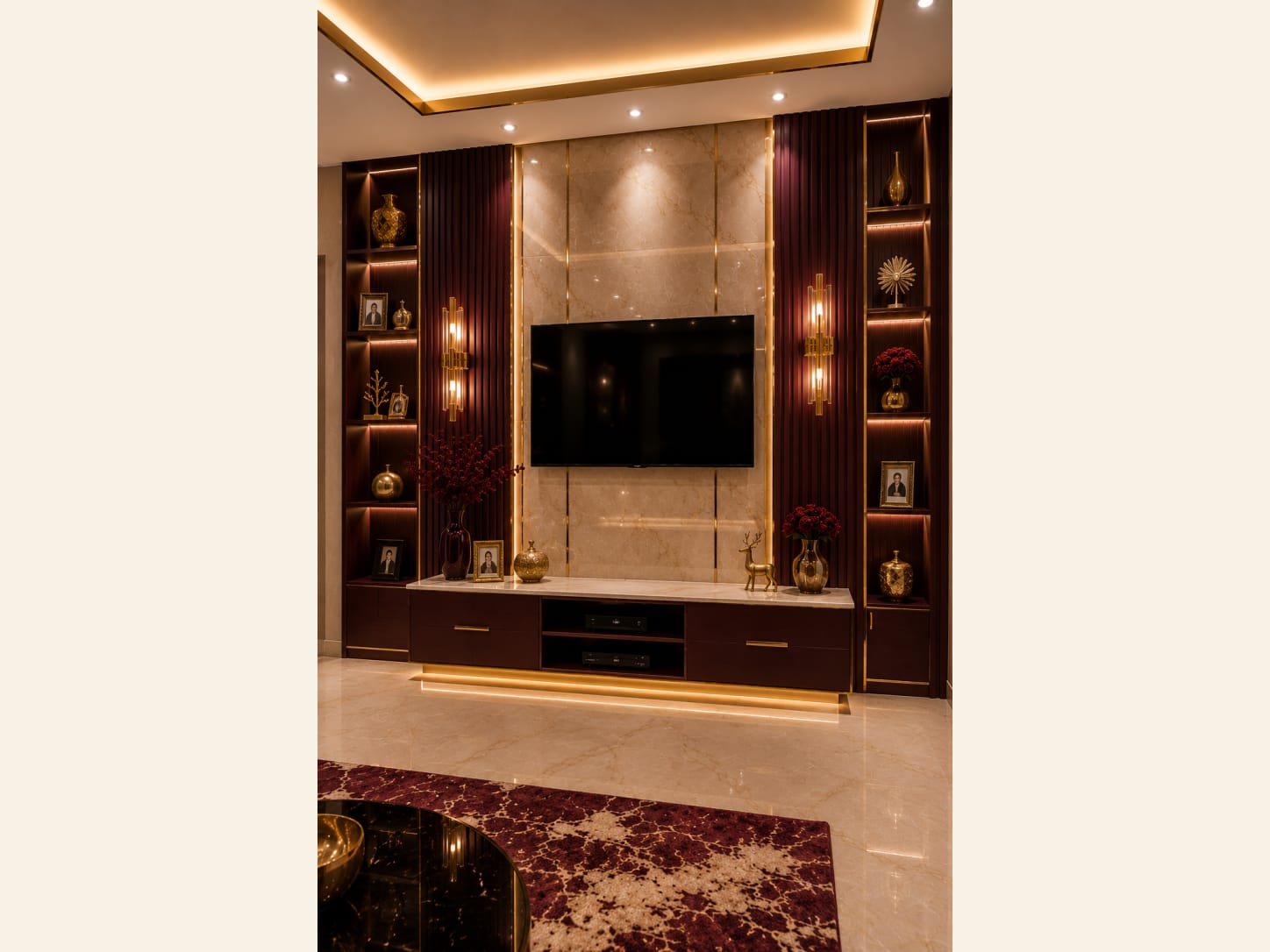
A dramatic living room TV wall in maroon fluted panels, beige marble and gold trim, framed by backlit display shelves. Rich, symmetrical and made to be the room's showpiece. The wall is built on symmetry: a bright beige marble panel in the centre, flanked by matching maroon fluted columns and lit display shelves. That balance is what makes it feel designed rather than busy. The marble centre keeps the dark maroon from swallowing the room it bounces light around the TV and stops the screen looking like a black hole. Gold trim lines and hidden LED strips add sparkle and lead your eye up and across the whole composition. Key details: Beige marble centre panel, a book-matched slab behind the TV that brightens the whole wall; Maroon fluted side panels, vertical grooved columns that add texture and richness; Backlit display shelves, lit niches framing the wall to show off vases and photo frames; Gold wall sconces, slim linear brass lights flanking the screen for a warm glow; Marble-top media console, a low maroon and marble unit with hidden storage below; Gold and burgundy accent decor, brass vases, red florals and a deer figure for warmth.
What to verify before recreating the look
For dark tv wall design ideas, the practical decisions have to support charcoal, navy and black with controlled lighting. Plan screen height, viewing distance, ventilation, sockets, data points and speaker locations before building the decorative wall. Keep service panels and drivers accessible, use diffusers over LED strips and confirm the wall can support the television and any stone or cabinetry. Highly polished surfaces can reflect the screen and windows, so inspect samples from the actual seating position. Conceal cables through a compliant route rather than trapping adapters inside an unventilated void.
How to edit these dark tv wall design ideas for a real room
Use “A Navy Built-In Media Wall with Lit Shelving and Brass Lights” and “A Maroon and Gold Marble TV Feature Wall With Backlit Shelves” as two boundaries rather than a shopping list: identify which end better matches your room's scale, then keep the strongest idea connected to charcoal, navy and black with controlled lighting. Resolve screen height, viewing distance, ventilation, cable access and reflected glare before adding decorative layers. The finished space should preserve the useful relationship you noticed in the reference while leaving room for the objects, habits and maintenance needs that make it yours.
Join the conversation
Share your thoughts on this room