

Gold and black marble console table ideas with presence
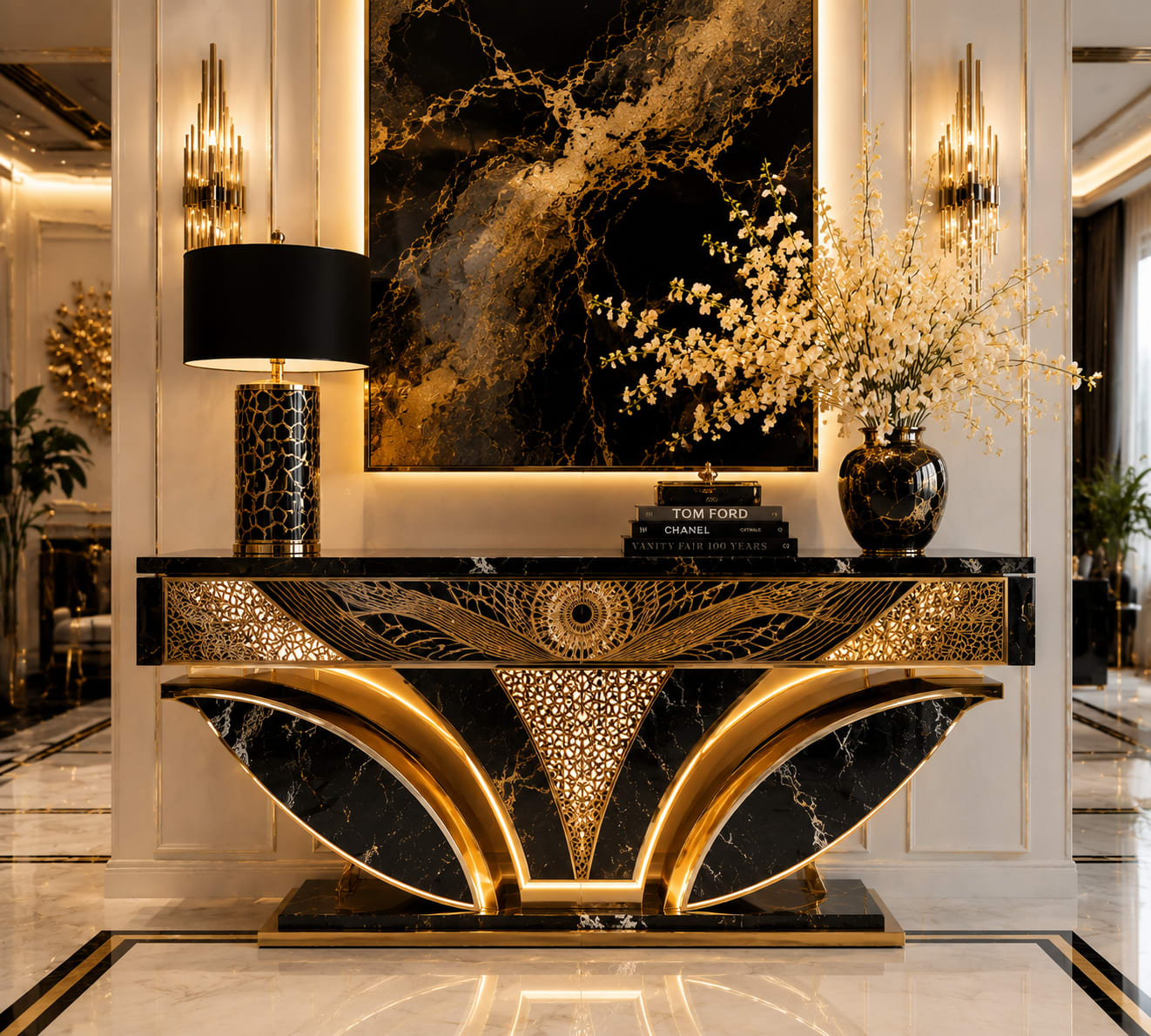
Make a fan motif the centre of the composition

This design has several expensive-looking ingredients, but one idea keeps them organised: the fan. Its ribs spread through the drawer front, narrow into a perforated central point and reappear in the curved supports below. That repetition matters more than the amount of gold. The lamp, vase and artwork stay within the same black, cream and warm-metal palette, so they read as part of the room rather than a shop display. If you adapt the look, choose either an intricate front or a highly figured top; making both equally loud can flatten the hierarchy. Ask how the perforated panels open for cleaning and whether light can be serviced from behind.
Layer nested arches beneath a straight stone top
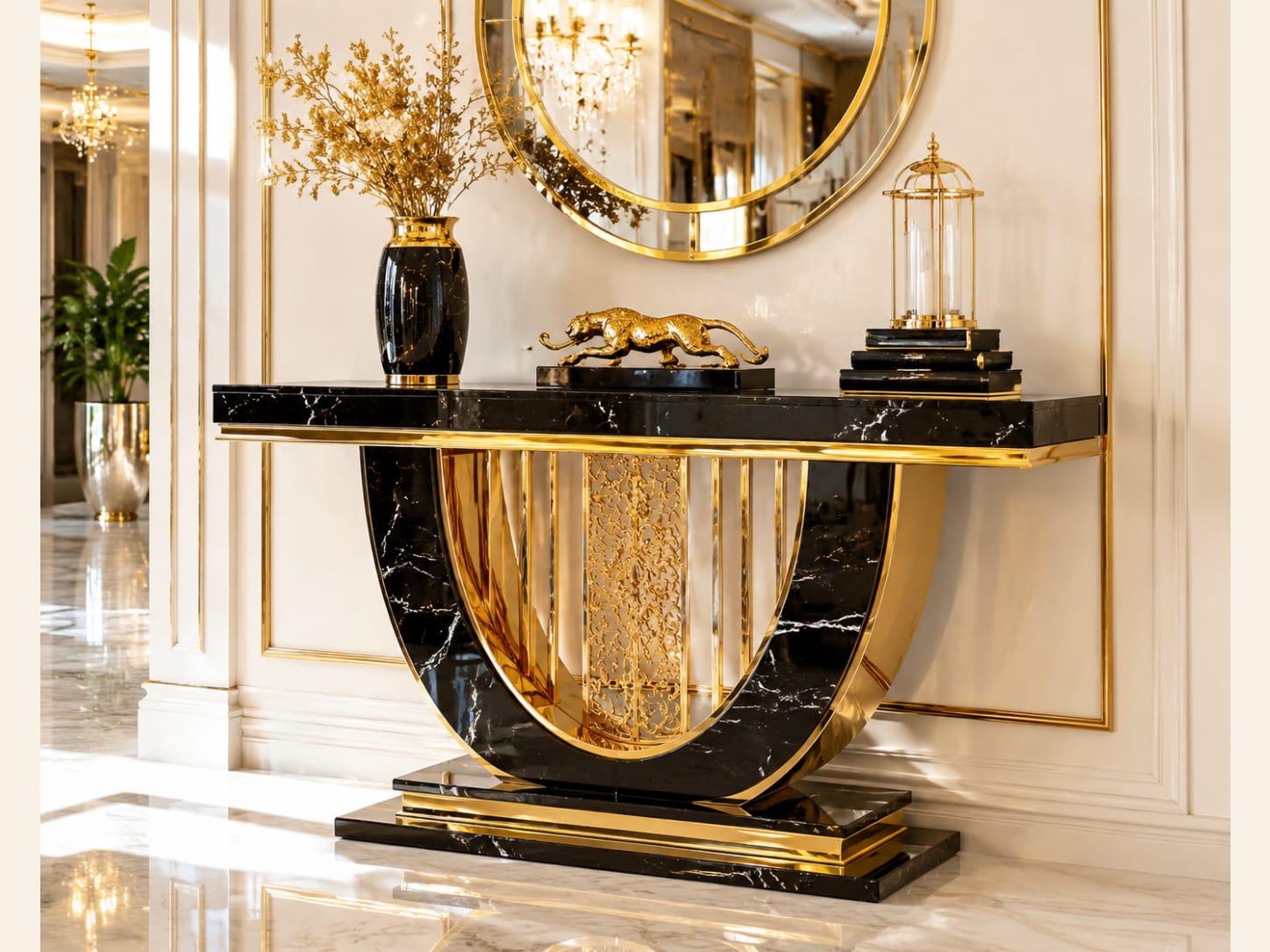
A thick black top and stepped plinth give this console a firm horizontal frame. Inside it, overlapping arches create movement without projecting far beyond the furniture. The pierced panel at the centre is small enough to feel like jewellery rather than another competing pattern. A round mirror is a smart partner because it repeats the curves at a larger, calmer scale. What deserves scrutiny is the base: several polished layers meet close to the floor, where dust and fingerprints show quickly. A brushed inner finish or fewer reflective bands would make everyday upkeep easier while preserving the same silhouette.
Use one sweeping V instead of many small details
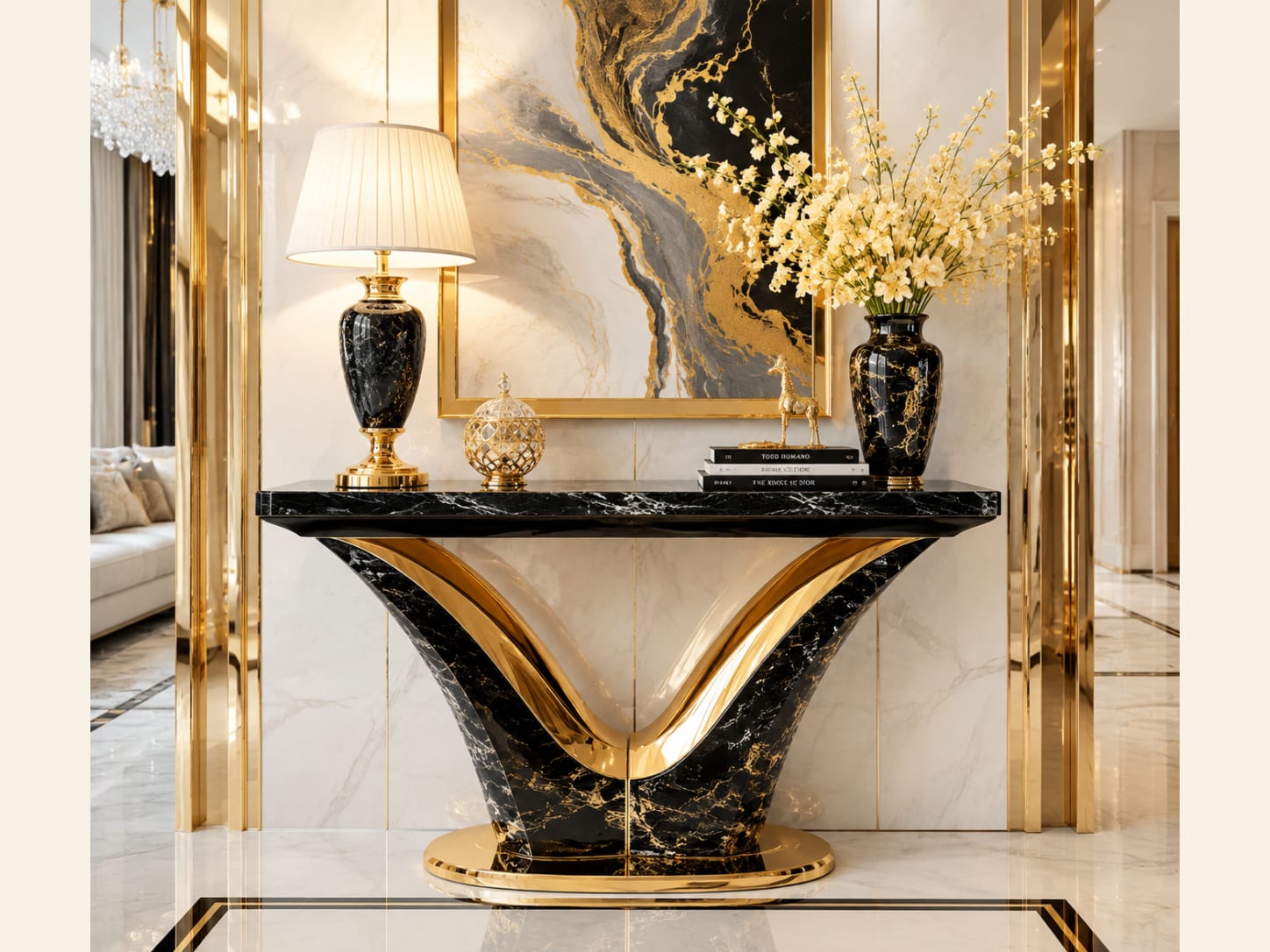
Of the seven, this is the easiest to translate into a contemporary house. Two dark stone wings rise into a broad V, while a gold inset traces the same gesture and brightens the centre. There is no drawer box, carved apron or lit grille to compete with the form. The artwork supplies the visual complexity instead. Notice how its black-and-gold movement is looser than the precise base; matching the pattern exactly would have felt forced. The broad foot should be checked against skirting boards and floor joints, and the narrow waist needs a properly engineered connection to the top rather than relying on the appearance of balance.
Turn an illuminated oval into a single focal point
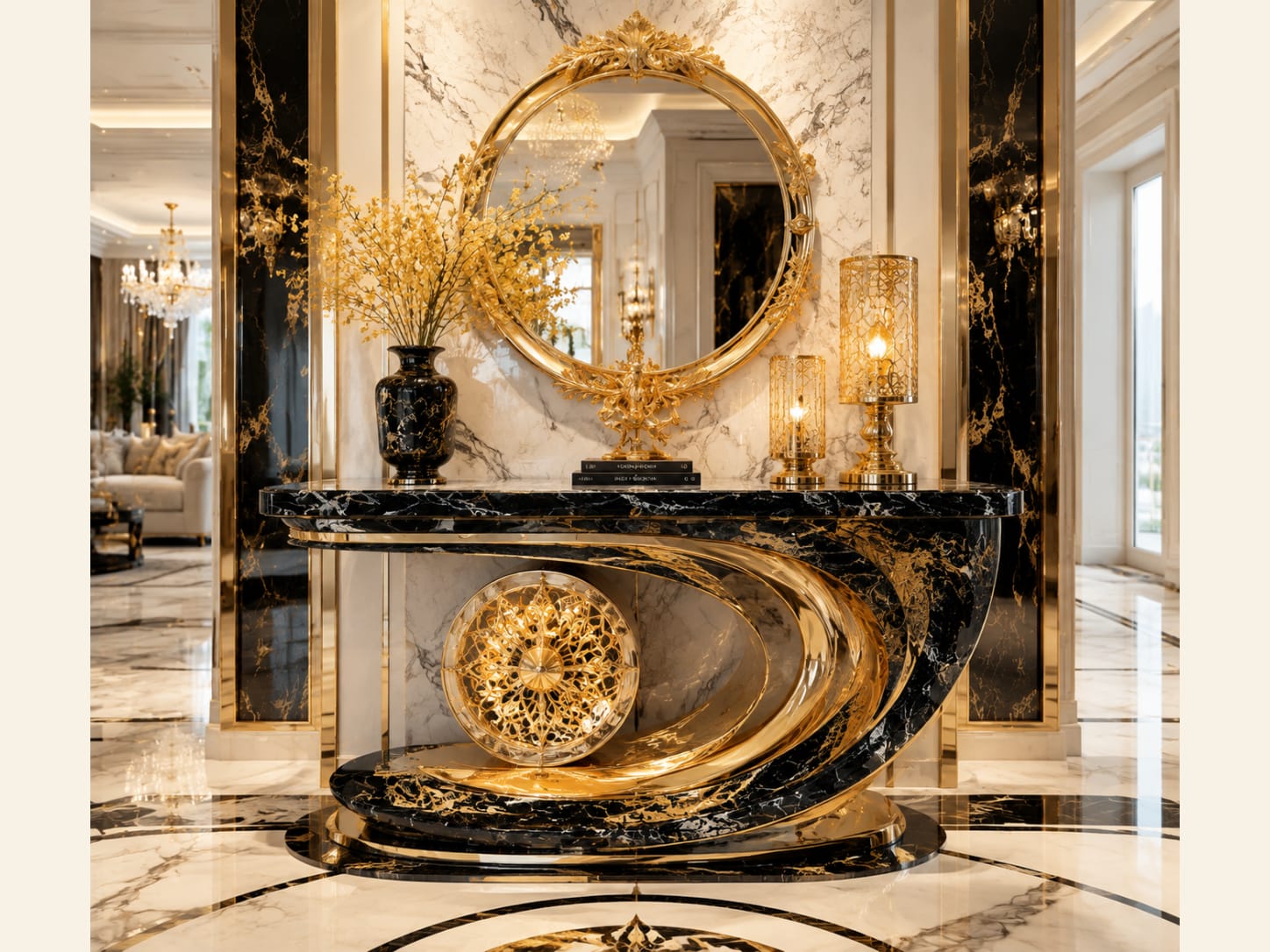
Here the base curls around a glowing circular medallion, almost like an oversized piece of jewellery. It works because the light is concentrated in one place. If every outline glowed, the console would start to resemble signage. The top remains long and useful, while the open left side stops the dark stone from becoming a solid wall of material. In a real foyer, route the cable through the base and position a socket behind it before the table arrives. Specify a removable medallion or rear access panel too; an integrated light that cannot be repaired will become a dark decorative insert sooner than expected.
Let an asymmetric C-base create the movement

The C-shaped support gives this console a sense of motion that a symmetrical foyer arrangement often lacks. A slim ribbed leg at the opposite end visually steadies the top, while the fretwork drawer front provides useful concealed storage. This is a good example of why asymmetry needs discipline: the lamp sits over the heavy curve, the vase balances it from the other side and the artwork remains centred on the wall rather than chasing the furniture below. Before commissioning anything similar, ask for a structural drawing. The delicate right support may need an internal steel frame, and the glowing inner edge must not become the only thing holding the viewer's attention.
Build a formal fan from ribs and marble arcs

This version is architectural rather than delicate. Four sweeping arcs sit inside a rectangular frame, and a tight bundle of vertical ribs marks the centre. The octagonal mirror continues the geometry without repeating the fan. Because the furniture already has strong symmetry, the styling can be slightly uneven: tall branches on one side, a smaller crystal object on the other and books between them. The low illuminated plinth looks dramatic at night, but it also highlights every speck of dust on the glossy floor. Consider a softer reflected glow and a satin rather than mirror-polished finish if the entryway is used every day.
Reserve full scrollwork for a genuinely grand hall
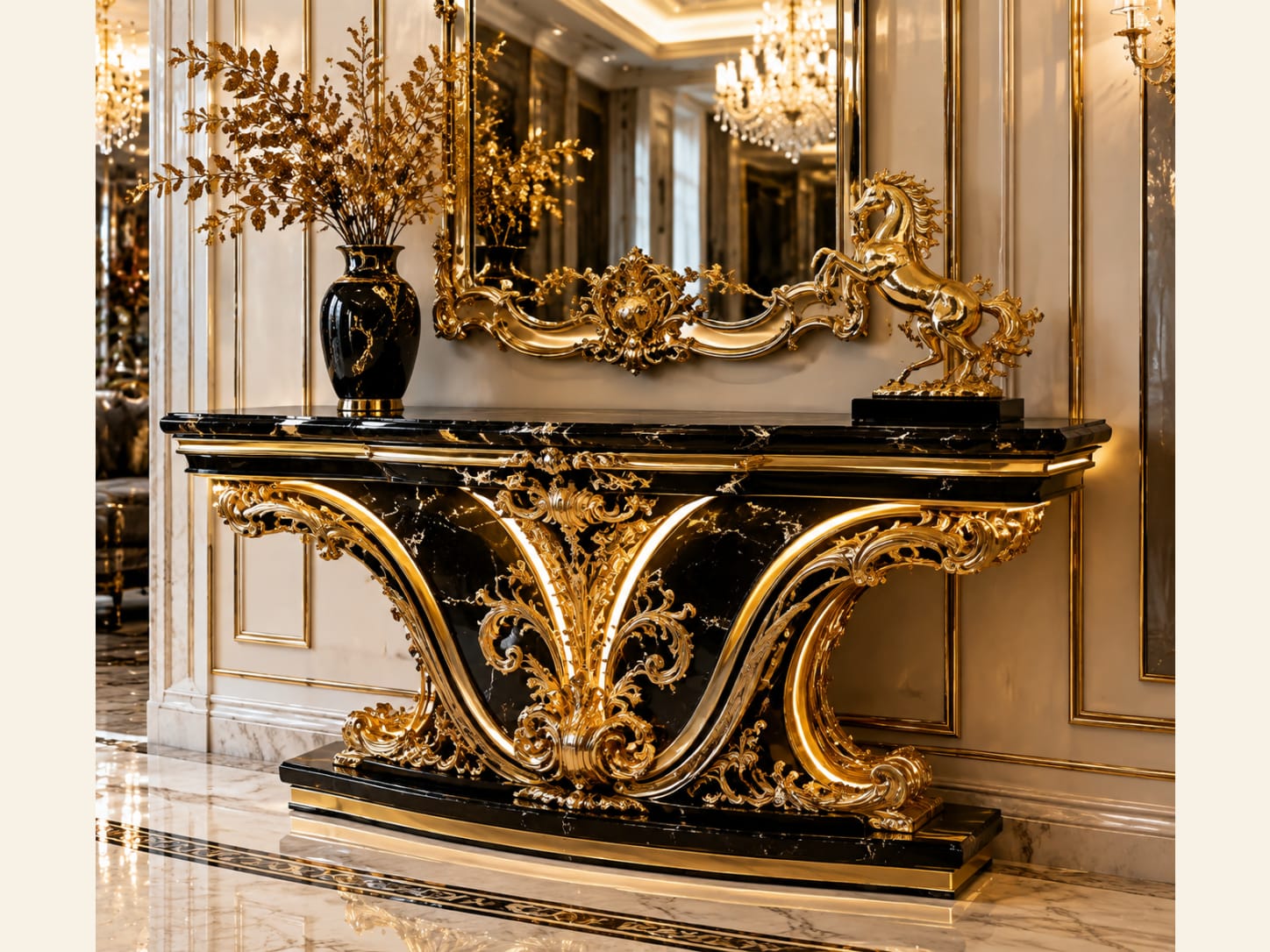
The final concept is deliberately maximal: black stone is wrapped with gold acanthus scrolls, a carved crest runs across the apron and the mirror has its own ornamental frame. In a double-height or classically panelled hall, that density can feel proportionate. In an ordinary corridor it would overwhelm both the wall and the walking route. The lesson is not that more carving equals more luxury; it is that decoration needs architectural support. If your room lacks tall ceilings, deep mouldings and generous width, borrow one element, the curved supports or the crest, and simplify everything else. Also confirm that applied ornaments have no sharp projections where coats and bags pass.
What makes ornate look considered rather than crowded?
The eye needs a clear first read. In these designs it might be a fan, a V, a glowing oval or a carved scroll. Once that shape has registered, the smaller details can reward a closer look. Trouble begins when the top, base, wall, mirror and accessories all compete at the same intensity. Choose one highly patterned surface, one dominant silhouette and one quieter backdrop. A marble top with active white veining may need a plain panelled wall; an intricate fretwork drawer can sit below a calmer stone top. Restraint around an ornate object does not make the room less luxurious. It is what lets the workmanship look intentional.
Measure the base, not only the tabletop
Curved and flared bases often occupy more floor than their tops suggest. Mark the widest outline with painter's tape, including the plinth, and walk past it carrying a bag or laundry basket. A console around 25 to 35 cm deep works in many hallways; a large foyer may handle 35 to 45 cm. Aim to keep roughly 90 cm of clear passage, with more space near a front door, staircase or pinch point. Check wall switches, radiator valves and skirting depth as well. A low plinth that looks perfectly flush in a visualization may sit several centimetres away from a real wall because of the baseboard.
Choose materials by touch and maintenance
- Natural black marble has genuine depth and variation, but it is heavy and can show etching, pale marks and dust. Ask to see the actual slab and its sealing requirements.
- Porcelain or engineered stone can give a controlled dark pattern with easier maintenance. Curved cladding and neat mitred edges still require skilled fabrication.
- Polished brass or stainless steel with a gold finish produces sharp reflections but marks easily. Brushed, satin or antiqued metal is calmer and more forgiving in a busy entrance.
- Laser-cut fretwork needs enough spacing to clean and a removable backing if it contains light. Very fine patterns can look muddy from across the room.
- Applied mouldings and scrolls should be fixed securely, finished on every visible edge and kept away from knees, sleeves and bags.
Use lighting to reveal depth, not outline everything
Warm integrated light can separate black stone from gold metal and make pierced panels feel deeper. The most convincing examples illuminate one recess or wash light onto the wall; they do not trace every curve. Ask for a continuous diffuser so individual LED dots remain hidden, a warm source close to 2700K, separate dimming from the ceiling light and access to the driver. Test the stone sample under the proposed light too. Some black surfaces turn brown or grey under a very warm strip, while highly polished gold can produce distracting hotspots.
Style the top in three uneven groups
Start with one tall anchor: a shaded lamp, branches or a substantial vase. Add a low group near the middle, such as two books with a small object, then finish with one quieter piece on the opposite side. The gaps matter. They reveal the stone and prevent the display from merging into one continuous band of objects. If the base is symmetrical, the accessories do not need to be. Slight imbalance makes a formal console feel inhabited. Keep practical items in a drawer or one small tray rather than allowing keys, post and chargers to spread across the entire top.
Questions to take to a maker or supplier
- What is structural, and what is decorative cladding?
- How is the stone top mechanically fixed and supported across its full span?
- Does the top or plinth separate for delivery, and will every part fit through the door or lift?
- Where is the centre of gravity on an asymmetric or narrow-waisted base?
- Should the table be restrained to the wall, particularly around children or pets?
- Can LED channels, drivers and fretwork backing panels be removed for repair and cleaning?
- Which finish sample best matches the room's existing handles, lights and mirror frame?
Pick the idea your architecture can support
A good statement console looks as though it belongs to the room, not as though it has been parked there for the photograph. The sweeping V suits a cleaner contemporary interior; the ribbed fan works with stepped mirrors and geometric lighting; the full scrollwork needs classical mouldings and genuine space around it. Start with the shape that echoes something already present, an arch, a fan-shaped light, a curved stair or a panel rhythm, then reduce the number of finishes. When proportion and construction are resolved first, ornament becomes character rather than clutter.
Join the conversation
Share your thoughts on this room