

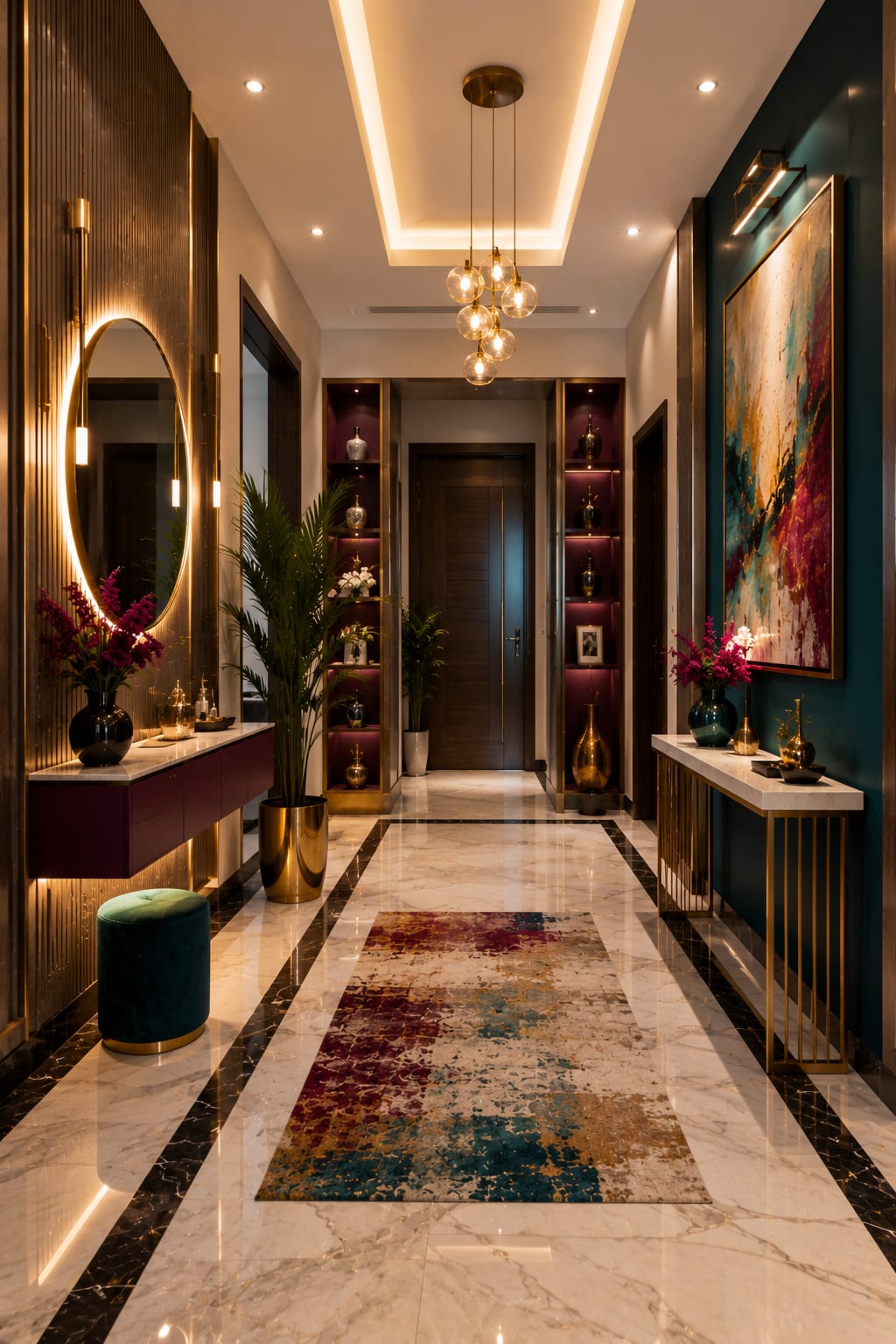
Start with the undertone, not the colour name
A jewel tone can lean warm, cool or almost neutral depending on the light around it. Teal becomes calmer beside walnut, plum looks richer beside cream marble, and maroon becomes more architectural when repeated in a runner rather than scattered across accessories. Before committing to paint or panels, view a large sample under daylight and the evening bulbs you will actually use. Then choose one metal finish. Brushed or antiqued gold is easier to live with than highly polished brass because it produces fewer hotspots around mirrors and glossy floors.
Six entryways, six different levels of drama
Use black and brass as a preview of the rooms beyond
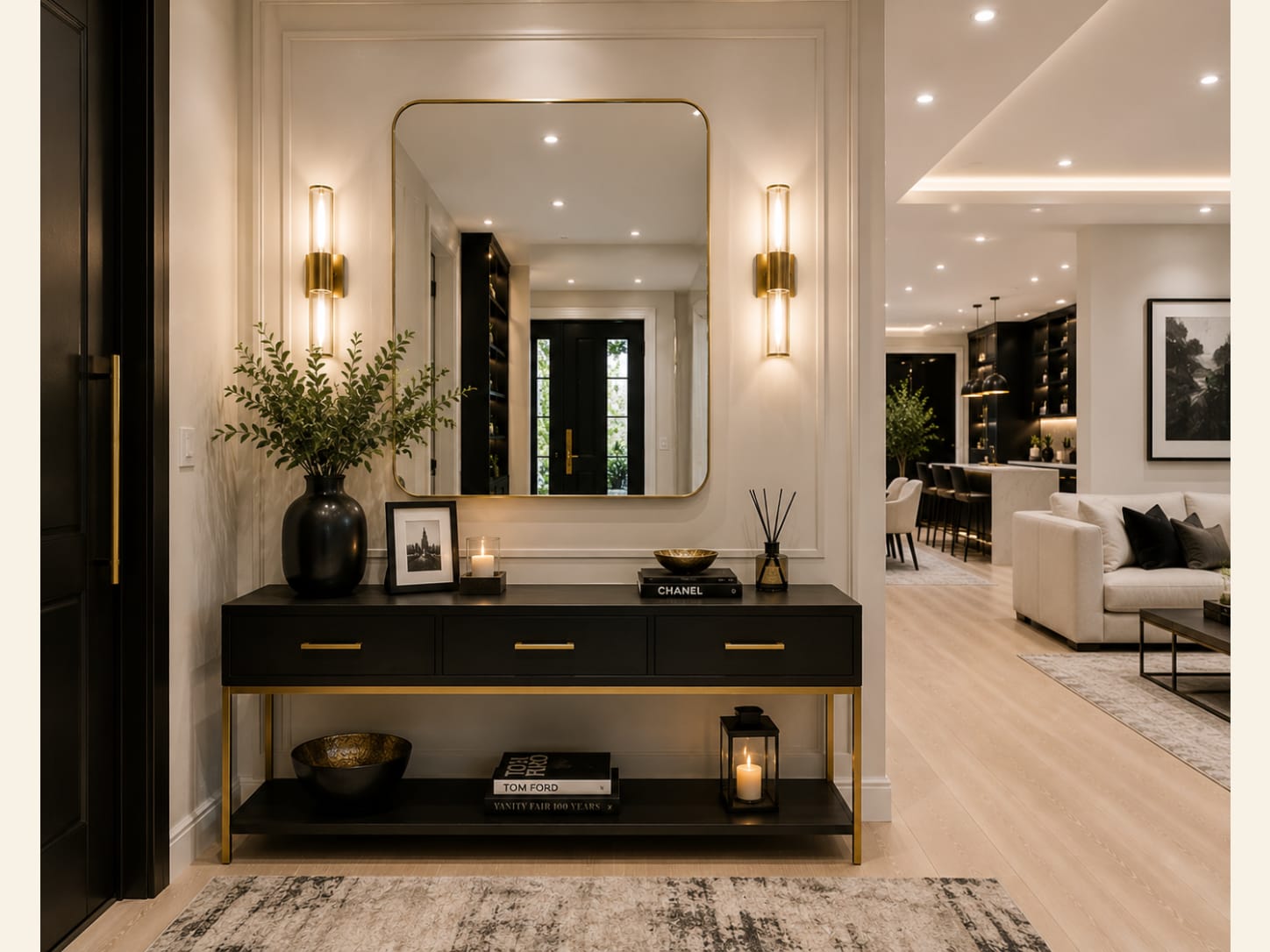
This is the most restrained design in the group, but it still makes a strong first impression. A black console sits on a slim brass frame, so the dark finish feels grounded without becoming a heavy block in the walkway. The rounded brass mirror softens the wall panelling and throws light back toward the door, while matching sconces make the vignette useful after sunset. What makes the room convincing is the sightline into the living space: black and brass continue beyond the hall, so the entry acts as an introduction rather than an unrelated display. Keep the styling just as controlled, with one tall vase, a shallow tray and a short stack of books. Before copying it, check that the mirror reflects something intentional and that the console leaves comfortable passage when the front door is open.
Balance deep teal with fluted walnut and a quiet runner
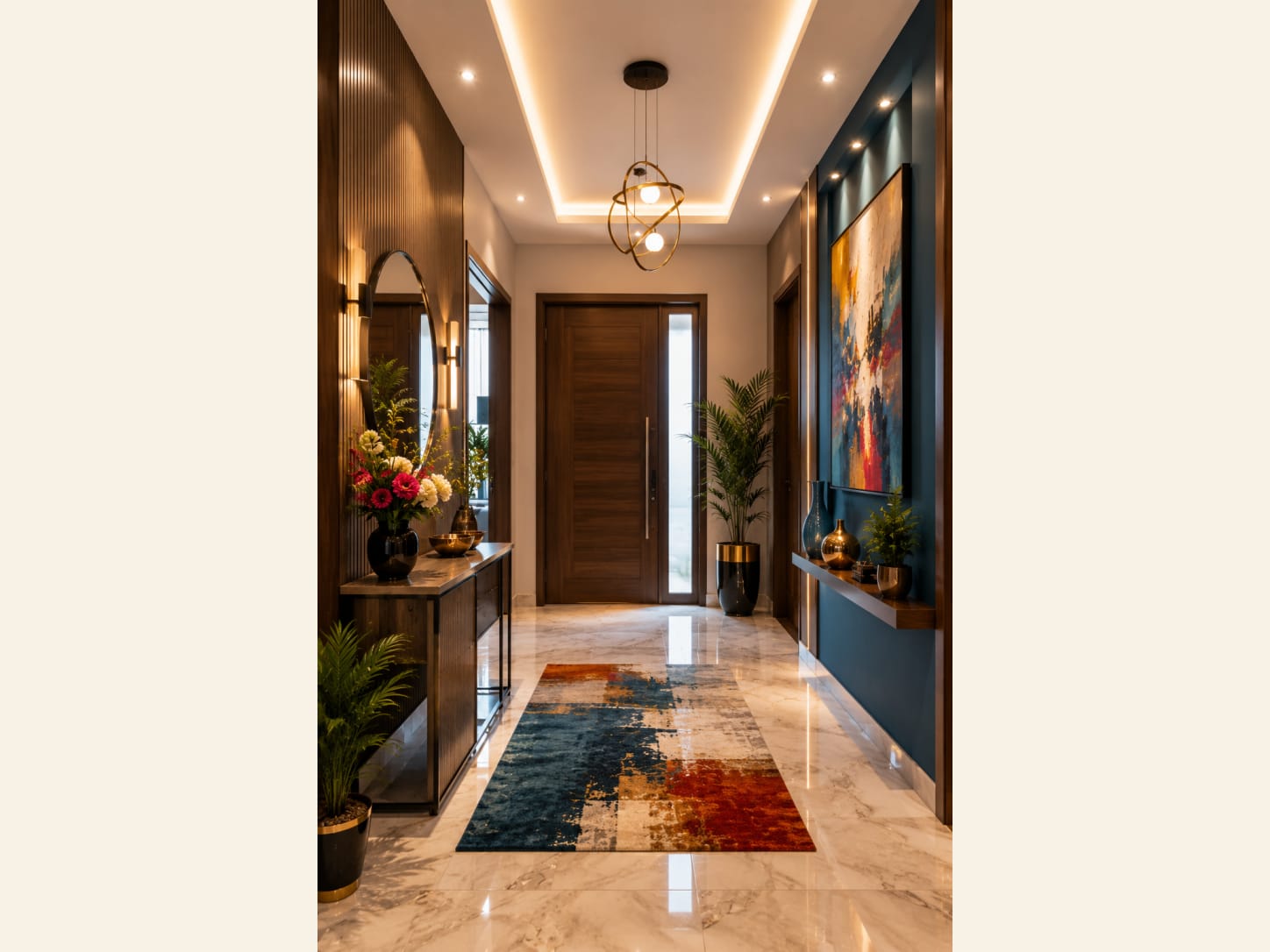
Warm walnut on one wall and deep teal on the other create contrast without splitting the hallway into two separate schemes. Gold works as the bridge: it appears in the orbital pendant, mirror frame and smaller accents rather than covering every surface. The fluted wood adds vertical rhythm and helps a long wall feel finished, while the abstract runner quietly repeats teal, rust and gold underfoot. If you recreate the look, decide whether the mirror or the pendant is the main sculptural piece; making both oversized can crowd a narrow entrance. Use the console as a practical drop zone and keep its styling below the centre of the mirror. A washable low-pile runner and a durable satin wall finish will cope better with shoes, bags and regular cleaning than delicate fabric or a high-gloss paint.
Confine magenta to lit niches and let teal hold the room

This is the boldest palette here, yet it stays readable because the colours have separate roles. Teal forms the broad backdrop, magenta is concentrated inside display niches, and gold outlines the architecture and lighting. The marble floor provides a pale pause between them. That hierarchy matters: spreading magenta across the consoles, rug, walls and accessories would remove the focal point. For a real hallway, mock up the niche colour with removable board before painting the recesses, and test the LED strip behind a diffuser so individual dots are not visible. Keep displayed objects pale, clear or metallic; multicoloured accessories would compete with the niches. If space is limited, borrow only the formula, one deep wall colour, one illuminated accent and one warm metal, rather than reproducing every decorative element.
Let a round mirror calm a fluted maroon wall
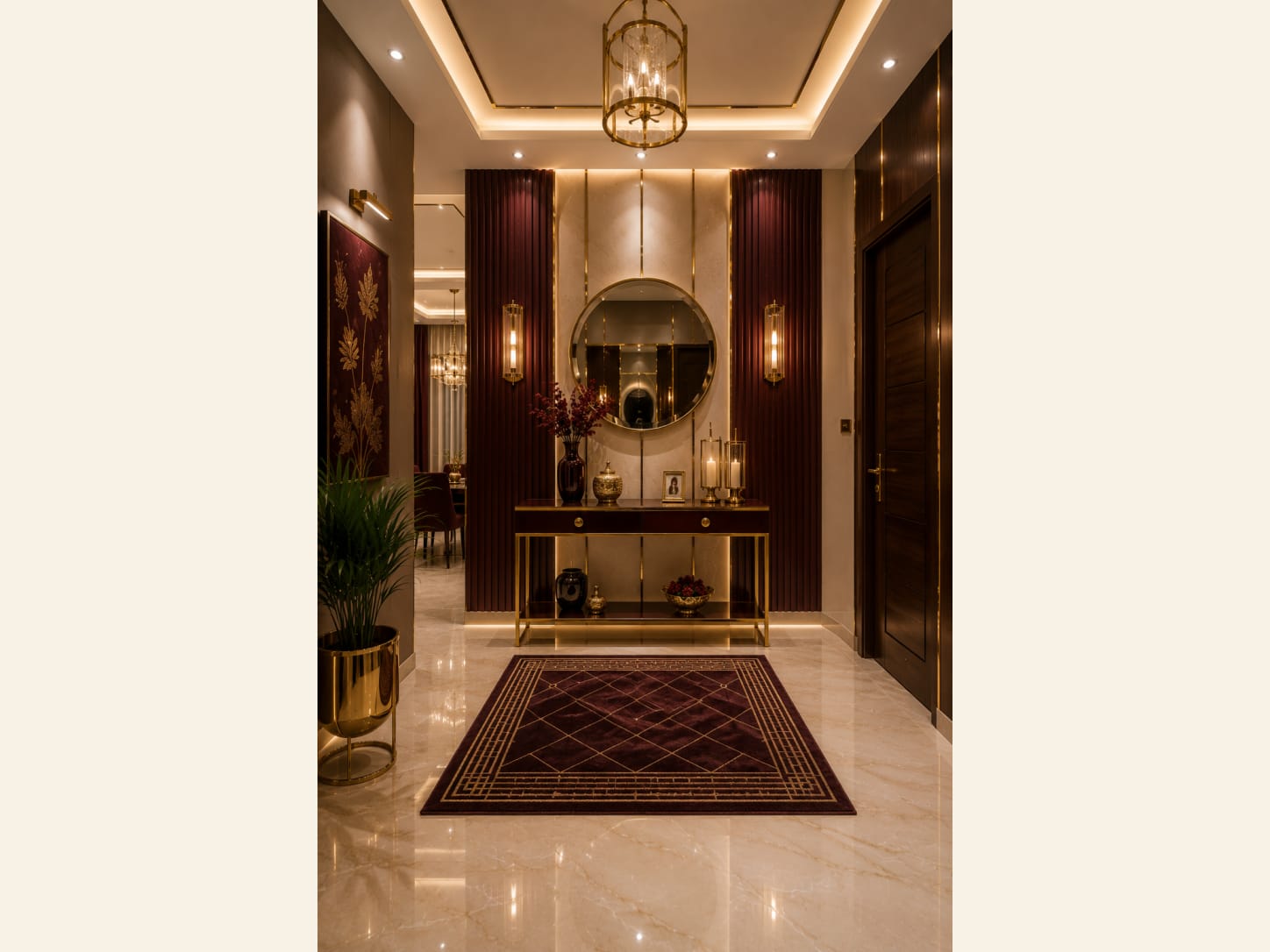
A tall fluted maroon wall gives this foyer its formality, but the large round mirror prevents all those vertical lines from feeling severe. Twin sconces establish symmetry, while the brass-and-wood console supplies concealed storage for the items that usually spoil an entrance. The best lesson is the use of height: the mirror, lights and narrow planter draw the eye upward, leaving the walking route visually clear. Measure the wall before choosing the mirror and aim for a frame narrower than the console, with enough breathing room above the surface for useful objects. A fluted treatment also collects dust along its grooves, so use it on one focal wall rather than wrapping a busy family hallway. Maroon already carries weight; warm white lighting and a cream or stone-coloured ceiling will stop it becoming flat at night.
Use plum, gold and cream to organise a long formal hallway

Plum panels, cream marble and warm gold give this long corridor a disciplined three-colour scheme. Repetition does most of the work: paired consoles create rhythm, slim sconces lead the eye forward and the dark timber doors provide a clear stopping point. The cascading chandelier is appropriate because the ceiling height and hallway length can support it; in a standard entrance, a lower lantern or compact cluster would preserve the idea without obstructing the view. Mirrored furniture can multiply glare and fingerprints, so a satin metal or dark wood console may be more practical while keeping the same silhouette. If you use a runner, centre it on the main route and confirm that doors clear its edge. The room feels luxurious because the large gestures repeat consistently, not because every object is decorative.
Build a moody entrance around stone, shadow and an organic mirror
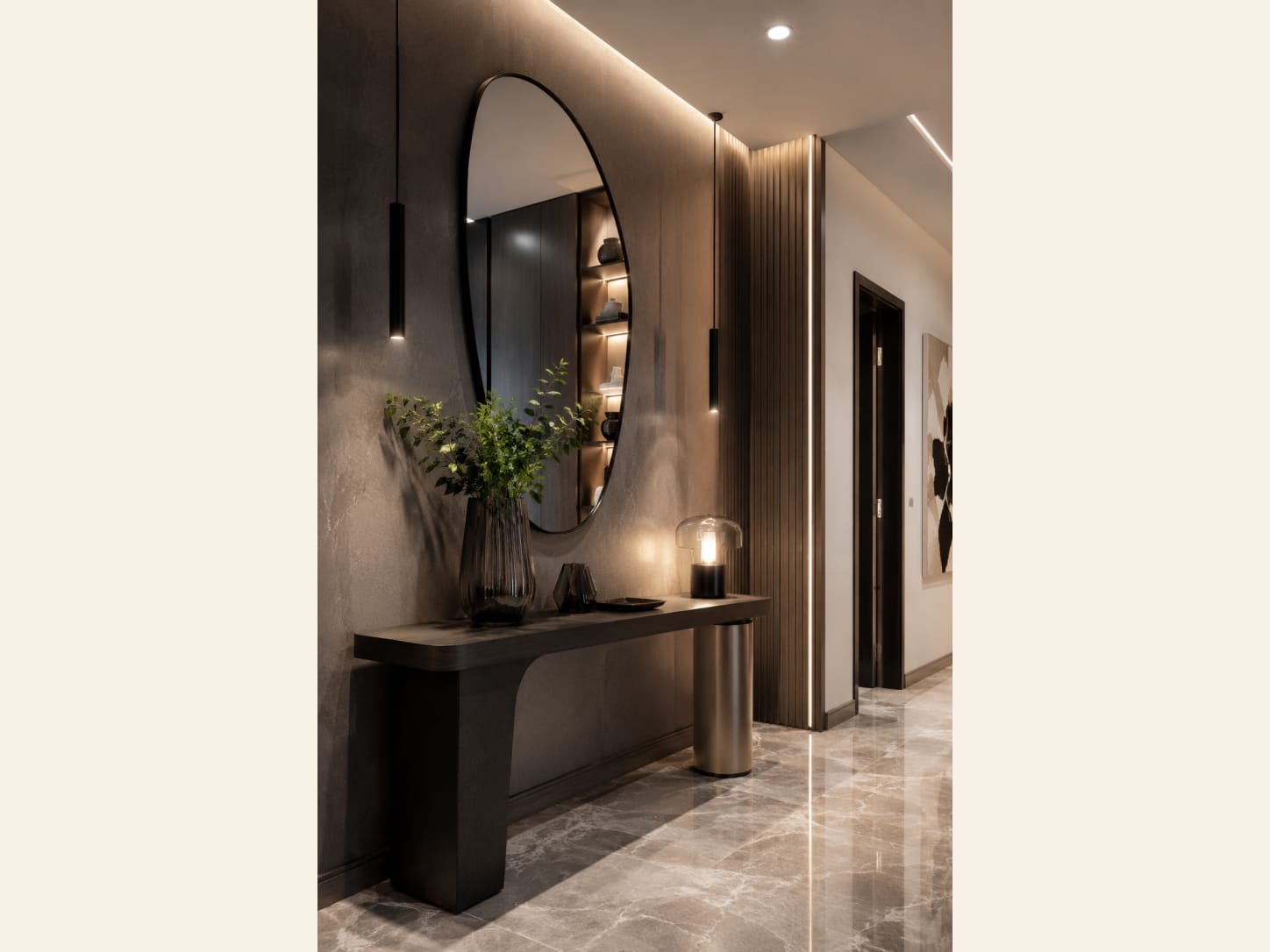
This design replaces bright jewel colour with a quieter combination of charcoal wood, warm stone and amber light. The irregular mirror is the focal point because its soft edge interrupts the straight hallway and timber slats. A low dark console anchors the composition, while slim pendants and a concealed LED strip wash the textured wall instead of lighting the floor harshly. It is a useful direction for a small entrance, provided the stone or plaster finish is not too rough around coats and bags. Ask for a sample under the proposed bulbs: some grey surfaces turn brown beneath very warm light. The styling should remain minimal, with one vase, one tray and perhaps a small lamp. The empty areas around them are part of the design and keep the dark materials from feeling cramped.
Measure the arrival route before choosing the console
A render can make a console look slimmer than it is, especially when the base curves outward or the camera sits near the doorway. Mark the full footprint on the floor, including the widest part of the legs and the depth of skirting boards. Walk past it carrying shopping bags and open every nearby door. Many hallways work with a console around 25 to 35 centimetres deep, but circulation and local accessibility guidance matter more than a generic number. Wall-mounted or open-frame designs preserve more visible floor and are often safer in a tight route, provided the wall and fixings can support them.
Layer light instead of relying on one dramatic fixture
The chandeliers attract attention in these concepts, but the sconces, pendants and concealed strips are what make the colours readable. Use the ceiling light for general illumination, light the mirror or artwork separately and add one lower source near the console. Keep all visible sources within a similar warm range and put decorative circuits on dimmers where possible. Integrated LEDs need accessible drivers and continuous diffusers; a glowing niche that cannot be serviced will quickly become an expensive dark recess. Check reflections from mirrors, polished floors and brass before final installation so the brightest source is not repeated directly into the viewer's eyes.
Choose one idea to lead and let the rest support it
The most transferable lesson is restraint. The teal-and-magenta foyer succeeds because the niches contain the brightest colour. The maroon entryway relies on one fluted wall. The plum corridor uses repetition, while the moody stone scheme lets light reveal texture. Pick the feature that suits your architecture, then simplify the mirror, rug and accessories around it. A clear hierarchy will make modest materials look more considered than an entrance where every surface competes to appear luxurious.
Join the conversation
Share your thoughts on this room