

Luxury bedroom vanity ideas worth adapting
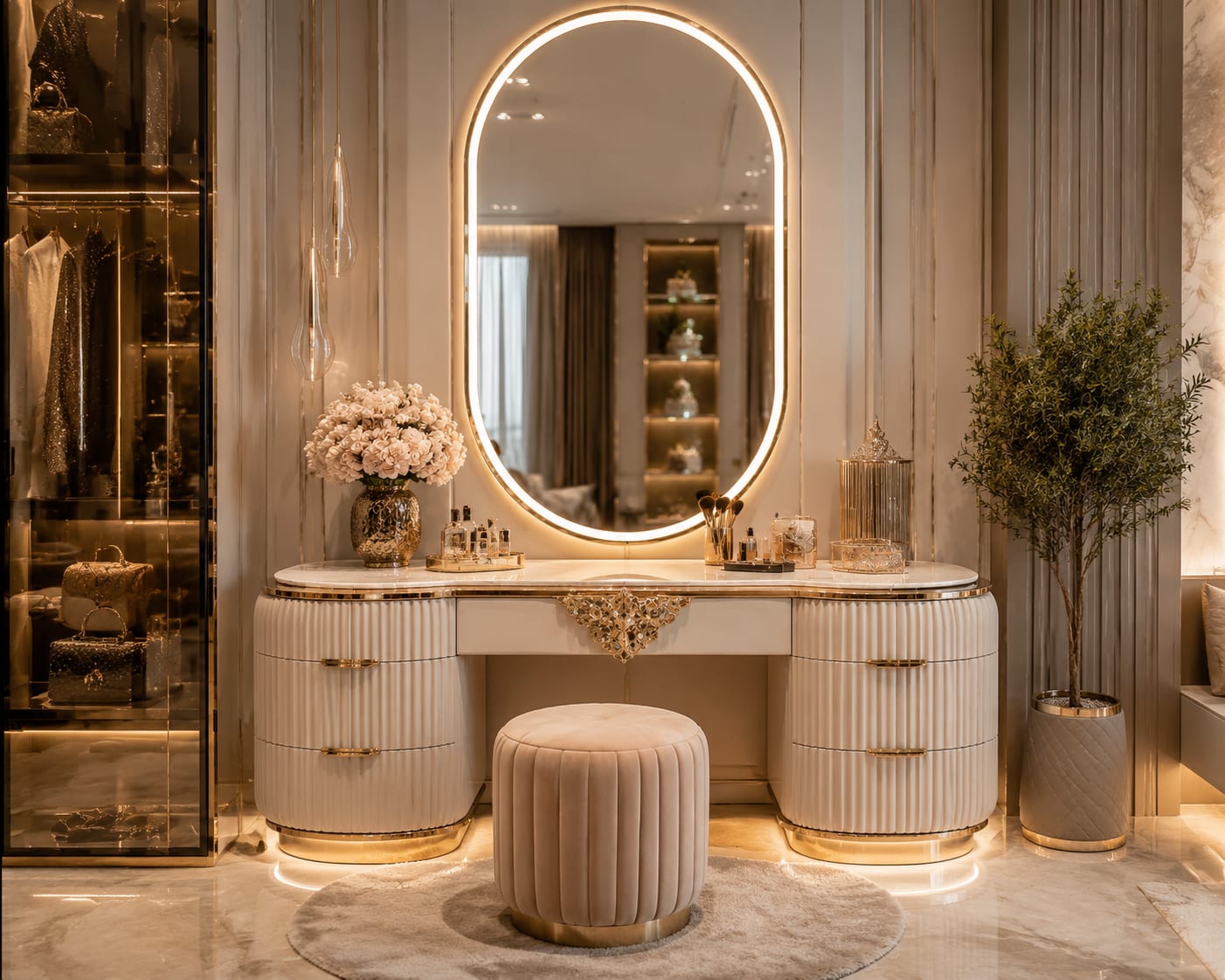
Frame an oval mirror with balanced drawer storage

This is a strong layout for someone who wants a glamorous vanity without giving up everyday storage. Matching curved drawer banks hold the composition steady, while the open centre leaves comfortable knee room. The tall oval mirror draws the eye upward and suits the narrow wall between the wardrobe and window. What to borrow: repeat the same radius on the drawer corners, stool and mirror. Keep the gold to slim outlines and handles so the cream finish remains the main event.
Let one floral mirror detail carry the romance

A ring of tiny illuminated leaves gives the round mirror a jewellery-like finish, but the rest of the vanity stays comparatively quiet. That restraint matters: the plain top, fluted fronts and small crystal-style pulls allow the decorative mirror to read clearly. A shell-shaped chair brings in blush without turning every surface pink. What to borrow: choose one romantic feature, then support it with two softer echoes, here the flowers and curved chair, rather than repeating motifs everywhere.
Use a sculptural floating front in a modern dressing area

Here the vanity front folds into a broad wave, giving a pale monochrome scheme enough character without a busy colour palette. The circular mirror sits inside a softly rounded wall recess, and two globe pendants bring task light to the working side. What to borrow: if the joinery is sculptural, simplify the accessories and keep the stool compact. Ask how the curved panels open and where the drawers actually end; a beautiful sweep is only useful when cosmetics remain easy to reach.
Build a proper Hollywood-light makeup station

This full-wall arrangement is closer to a working makeup station than a decorative dressing table. Bulbs run down both sides of the large mirror, drawer towers separate products by category, and shallow lit niches keep the prettier pieces visible. What to borrow: put frequently used products between seated shoulder height and the worktop; reserve the highest shelves for display. Use diffused, dimmable bulbs rather than exposed points that feel harsh at close range, and place outlets where hot tools can be set down safely.
Shape an asymmetrical mirror around the whole wall

An oversized free-form mirror turns an ordinary wall into the focal point and makes the dressing zone feel wider. The curved drawer ends follow its movement, while a window seat and glass-front wardrobe complete the room without copying the same shape. What to borrow: let a large mirror bridge separate storage elements, but mock up its outline in paper first. Check what it will reflect from the seated position; a dramatic mirror is less successful when it mainly doubles a doorway or cluttered shelf.
Choose symmetry when storage is the priority

Two equal drawer banks make this the most straightforward option for serious storage. The irregular mirror keeps the symmetrical cabinetry from looking like office furniture, while a small tabletop magnifying mirror handles detailed work. What to borrow: make the drawer interiors different even if the fronts match. Shallow top drawers suit brushes and pencils; deeper lower drawers can take palettes, hair tools and refill stock. The open centre should be wide enough that the chair does not knock the drawer handles when it turns.
Mix an organic mirror with display niches

This room uses negative space cleverly. A large pebble-shaped mirror anchors the centre, while a tall green-backed shelf and small arched niches break up the storage around it. The result feels collected rather than perfectly matched. What to borrow: vary the niche sizes according to what they will hold, and leave some empty. Display lighting should be softer than the face lighting; otherwise every object around the vanity competes with the mirror.
Stretch a floating vanity across a long wall

A wall-to-wall vanity can connect a wardrobe, makeup area and window seat into one piece of architecture. The floating centre keeps the floor visible, which stops a long run of cabinetry from feeling heavy. What to borrow: use drawers only where they earn their space and leave the central span visually light. Continuous under-cabinet illumination looks polished, but the LED channel and driver must remain accessible rather than being sealed permanently inside the joinery.
Create a calmer vanity for an evening routine

The final design is less sugary and more atmospheric. A floating curved top, softly backlit mirror and warm wall light create a quiet zone for skincare at the end of the day. Storage is mostly concealed, so the silhouette stays clean even beside glass wardrobes. What to borrow: put bright task lighting and warm ambient lighting on separate switches. You can use the stronger setting for makeup and the softer one at night without flooding the whole bedroom with ceiling light.
Plan the vanity around the routine, not the photograph
Before choosing the mirror shape, list what needs to happen here. Makeup requires even face lighting and shallow, divided storage. Hair styling needs a heat-safe landing place and an outlet that does not leave a cord crossing the drawers. Skincare needs less equipment but benefits from a wipeable top and a cool, dark drawer for products. If two people share the vanity, a wider surface is useful, but separate drawer zones matter more than perfect symmetry.
Mark the proposed top and mirror on the wall with painter's tape. Sit at the intended height and check where your face lands in the reflection, then pull the stool out fully and walk behind it. This simple test catches more layout problems than choosing dimensions from a product page alone.
Get the mirror lighting right
- Aim for even illumination on both sides of the face. A glowing outline looks beautiful, but side lighting is what helps reduce shadows beneath the eyes and chin.
- Choose a high colour-rendering light source so skin tones and makeup colours look believable rather than grey or overly yellow.
- Put the vanity lights on a dimmer and keep them separate from shelf and cove lighting.
- Avoid relying only on a pendant above the head. It can create strong downward shadows even when the room itself looks bright.
- Plan switches, outlets and LED drivers before the mirror and cabinetry are fitted, and keep service points accessible.
Dimensions to test before ordering joinery
A vanity top around 45 to 55 cm deep suits many dressing routines, though a compact floating ledge can be shallower. Seated worktops commonly fall near desk height, roughly 72 to 76 cm, but the correct figure depends on the chair and the person using it. Leave comfortable knee width and make sure any apron or drawer beneath the top does not crowd the thighs. These are planning ranges, not construction rules: measure the user, stool and available route together.
Choose finishes that can handle daily use
Cream lacquer, reeded fronts and brushed gold create the luxurious look seen in these concepts, but the top does the hardest work. Engineered stone, porcelain or another sealed, non-porous surface is generally easier around makeup and skincare than an unprotected timber top. If you love natural marble, ask how it should be sealed and accept that perfume, oils and pigments need to be wiped quickly. On handles and mirror trim, brushed metal is usually more forgiving of fingerprints than a perfectly polished finish.
A final edit before you commit
Pick the idea that solves your room's real limitation. Use balanced drawer banks when storage is tight, a floating design when the room feels crowded, Hollywood-style side lighting when accuracy matters, and an oversized organic mirror when a long blank wall needs purpose. Then remove one feature from the mood board. Luxury usually appears in the quality of the lighting, proportions and joinery long before it appears in the number of decorative details.
Join the conversation
Share your thoughts on this room