

deep neutrals, pale upholstery and warm metal: what to compare before choosing a favourite
Within navy and charcoal bedroom ideas, a shared subject does not make the rooms interchangeable. Use "A Navy Floating Bed and Marble Master Bedroom That Feels Custom-Built" as the midpoint and compare where it places contrast, how much empty surface it protects and whether its lighting is functional or mainly atmospheric. Those differences show whether its approach to deep neutrals, pale upholstery and warm metal can be adapted honestly to your own measurements and routine.
6 rooms, each with its own design decision
A Navy Panelled Bedroom with an Arched Cream Headboard

A navy panelled feature wall behind a curved cream upholstered headboard, with layered linen bedding, navy velvet cushions and brass task lamps on dark wood nightstands. The mouldings on the feature wall are painted the same navy as the wall itself, so you read depth and shadow rather than a striped pattern, the single most common panelling mistake. Against it, the headboard is curved and cream, and that soft arch is what stops a rectilinear room feeling like a grid. Brass task lamps replace table lamps, freeing the nightstands and pushing light exactly where you read. Note that only one wall is navy; the other three stay pale, which is why the room feels calm rather than closed in. And the bedding is deliberately texture-led, linen, knit, velvet, because in a two-colour room, texture is the only thing left to create interest. Key details: Navy panelled feature wall, applied mouldings painted the same shade as the wall; Arched cream headboard, a curved upholstered form softening the panelled grid; Layered linen bedding, cream and greige layers with a chunky knit throw; Navy velvet cushions, pulling the wall colour onto the bed; Brass swing-arm lamps, wall-mounted reading lights either side; Dark wood nightstands, simple drawers with slim brass pulls; Faded blue rug, a muted pattern echoing the navy underfoot. Practical moves: Paint mouldings the same colour as the wall, contrast mouldings make a room busy. ; Keep navy to the wall behind the bed only; you never look at it while lying down.
A Charcoal Panelled Bedroom with a Cream Wingback Bed

A near-black panelled wall behind a cream tufted wingback bed, layered linen bedding, brass task lamps and a round brass nightstand, all softened by full-height sheer curtains. The wall behind the bed is charcoal with applied panel mouldings painted the same colour, so you read depth and shadow rather than stripes. That dark plane does two things: it makes the pale bed appear to glow, and it visually pushes the wall back so the room feels deeper. Everything else is layered neutrals, linen bedding, a cream tufted wingback, a taupe rug, a bench at the foot, with texture doing the work instead of colour. The brass is used sparingly but boldly: two adjustable task lamps and one solid round nightstand, which is enough to warm all that grey without turning the room gold. And crucially, only one wall is dark; the others stay pale, which is why the scheme reads calm rather than heavy. Key details: Charcoal panelled feature wall, applied mouldings painted the same near-black shade; Cream tufted wingback bed, a tall buttoned headboard with wrapped side wings; Layered linen bedding, cream and taupe layers with a chunky knit throw; Brass task lamps, adjustable arms mounted either side instead of table lamps; Round brass nightstand, a drum-shaped metal bedside adding warmth and curve; Cream bench on a gold frame, soft seating closing the foot of the bed; Sheer and taupe curtains, full-height layers diffusing daylight across the room. Practical moves: Paint the mouldings the same colour as the wall so they read as shadow, not pattern.
A Navy and Cream Master Bedroom with an Open Ensuite

A channel-tufted navy velvet headboard against panelled walls, cream bedding, brass sconces and a chandelier, with an open ensuite and a lit walk-in wardrobe beyond the bed. The channel-tufted velvet headboard is tall and wide enough to act as architecture, which means the wall behind it needs almost nothing, just quiet panelling and one piece of art. Because the navy is concentrated there, the rest of the room can be layered creams: bedding, boucle bench, boucle swivel chair. The brass is deliberately mixed in form but matched in tone, vertical tube sconces, a slim chandelier, thin drawer pulls, so it feels collected rather than bought as a set. The real luxury move is the open ensuite: leaving the bathroom and lit wardrobe visible instead of hidden behind doors borrows their light and depth, and makes the bedroom feel like a suite rather than a box. Key details: Channel-tufted navy velvet headboard, full-width, tall, with a soft curved top; Panelled walls, simple applied mouldings painted the same shade as the wall; Brass sconces and chandelier, vertical tube wall lights either side, a slim brass fitting above; Layered cream bedding, ivory linen with a navy velvet throw folded across the foot; Boucle bench and swivel chair, textured cream seating that softens all the hard lines; Open ensuite and lit wardrobe, a backlit round mirror and glass-front wardrobe visible from the bed. Practical moves: Keep navy to three touchpoints, headboard, throw, a couple of cushions. Any more and it closes the room in.
A Navy Floating Bed and Marble Master Bedroom That Feels Custom-Built
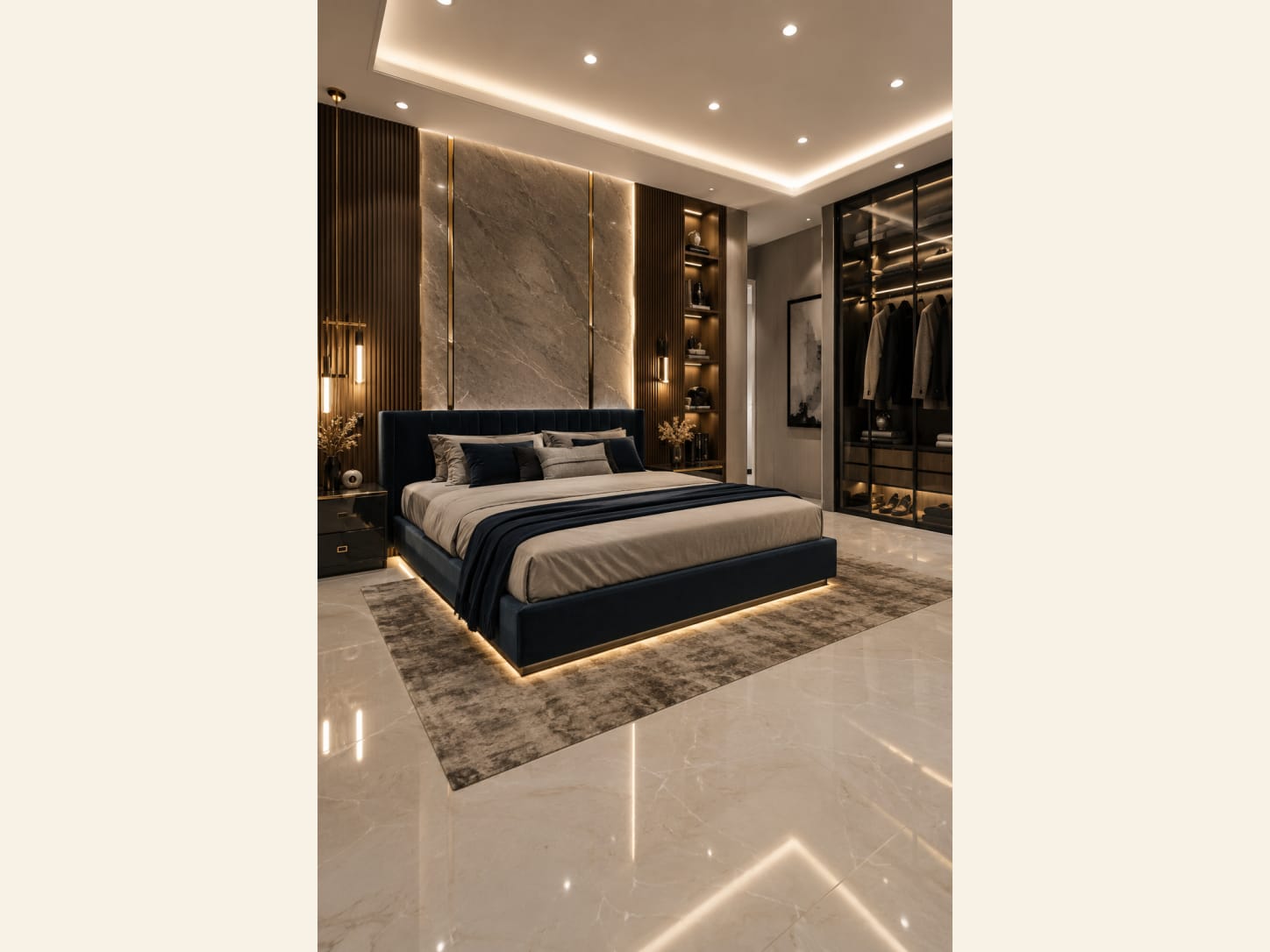
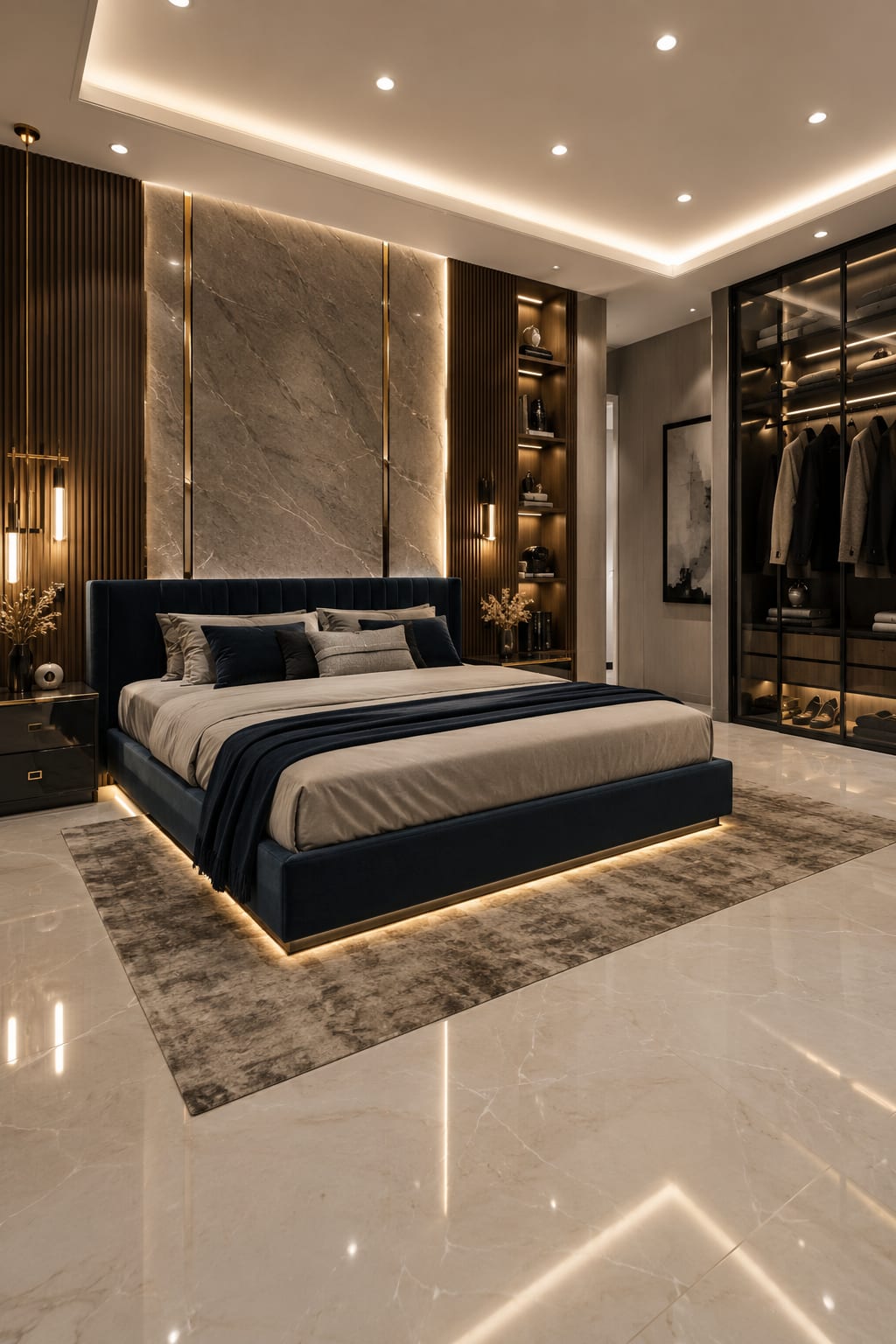
A sleek modern master bedroom with a navy velvet floating bed, backlit marble headboard wall and a glass walk-in wardrobe. This room is all about clean lines and considered materials, velvet, marble, warm wood and glass, with nothing extra. The navy bed reads almost black in shadow, which grounds the space against the pale marble floor. The LED strip under the floating base is what sells the whole thing, it makes a heavy bed look like it hovers and turns the frame into a soft nightlight. Key details: Navy velvet floating bed, a channel-tufted bed with a hidden base and LED underglow; Backlit marble headboard panel, a grey stone slab with slim gold trim lines behind the bed; Fluted wood side panels, warm vertical slats that frame the marble and add texture; Glass walk-in wardrobe, a black-framed glass closet with warm interior lighting; Black gloss nightstands, sleek lacquered units with brass edges either side of the bed; Cream marble floor with a grey rug, polished tiles softened by a textured area rug.
A Navy and Orange Boys' Football Bedroom

A modern boys' bedroom in navy, grey and orange with a navy channel headboard, football wall decor, lit display shelves for trophies, a study desk, a bean-bag corner, a geometric navy rug and a sputnik chandelier. This room hits the theme without feeling childish because it sticks to a smart navy-and-grey base and uses orange (and the football decor) only as accents. That means it still looks tidy and modern, and it can grow with the child instead of needing a redo in two years. Zoning the room into sleep, study and play areas, plus warm lit shelves for trophies, makes it genuinely useful, not just themed. Key details: Navy channel headboard, a padded navy headboard keeps the base grown-up and calm. ; Football wall decor, a few backlit football wall pieces carry the theme without covering every surface. ; Lit trophy shelves, warm-lit display shelves show off trophies, books and models. ; Study nook, a compact desk with its own task lamp gives a real place to work. ; Bean-bag play corner, a navy bean bag and open floor make a relaxed play zone. ; Geometric navy rug and orange accents, a bold navy-grey rug and a few orange cushions tie it together.. Practical moves: Keep the base navy and grey so the room stays smart and can grow with him. ; Use orange and a little football decor only as accents, not on every wall. ; Add a padded navy headboard and layer navy, grey and one orange cushion. ; Fit lit display shelves for trophies, books and models.
A Modern Bedroom with a Navy Accent Wall and Rust Accents
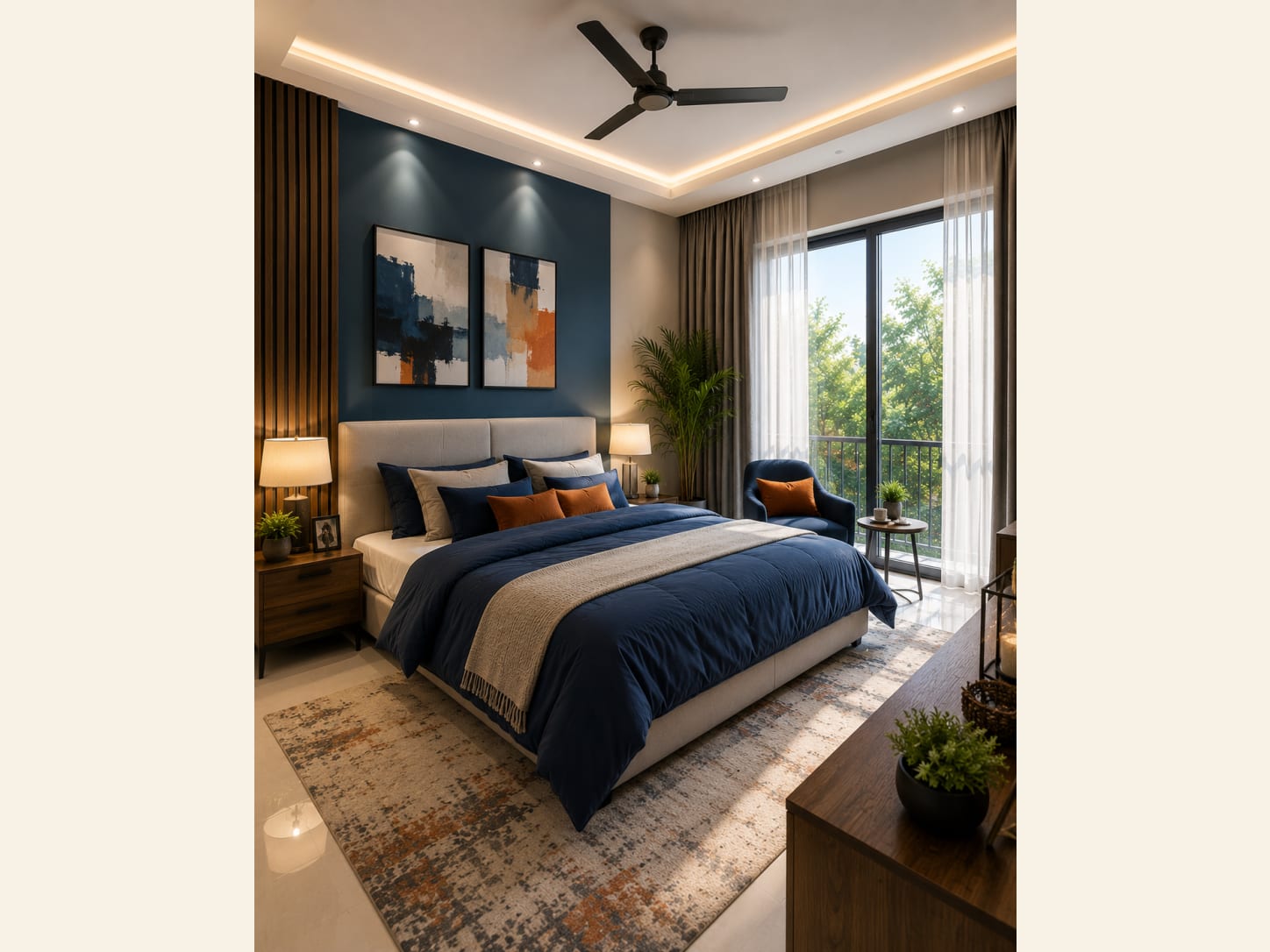
A modern bedroom with a deep navy accent wall, an upholstered headboard, navy bedding, rust pillows, a wood slat panel, abstract art, plants and a bright balcony view. It works because navy and rust are a warm-cool pairing that always feels considered. The deep navy wall makes the bed the focal point, while rust pillows and warm wood stop the blue feeling cold. A slat panel and abstract art add texture and personality, and daylight from the balcony keeps the darker tones from feeling heavy. It is a modern, boutique-hotel look that is still easy to relax in. Key details: A deep navy accent wall; A soft upholstered headboard; Navy bedding with rust pillows; A warm wood slat panel; Two abstract art prints; Warm bedside lamps and plants. Practical moves: Paint the wall behind the bed a deep navy. ; Add a soft, neutral upholstered headboard. ; Layer navy bedding with rust accent pillows. ; Bring in warm wood with a slat panel or nightstands. ; Hang two abstract prints above the bed. ; Keep the lamps warm and add a couple of plants..
What to verify before recreating the look
For navy and charcoal bedroom ideas, the practical decisions have to support deep neutrals, pale upholstery and warm metal. Begin with the bed position and a clear route to the door, wardrobe and window. Test headboard, bedside and desk dimensions with tape before ordering. Layer ambient, task and bedside lighting on separate controls, use lined window treatments where sleep needs stronger light control, and keep decorative wiring away from bedding and walking routes. A visualization can make a room appear wider than it is, so judge every feature against the measured wall rather than the camera angle.
How to edit these navy and charcoal bedroom ideas for a real room
Use “A Navy Panelled Bedroom with an Arched Cream Headboard” and “A Modern Bedroom with a Navy Accent Wall and Rust Accents” as two boundaries rather than a shopping list: identify which end better matches your room's scale, then keep the strongest idea connected to deep neutrals, pale upholstery and warm metal. Resolve bed position, wardrobe access, bedside clearance and controllable light before adding decorative layers. The finished space should preserve the useful relationship you noticed in the reference while leaving room for the objects, habits and maintenance needs that make it yours.
Join the conversation
Share your thoughts on this room