

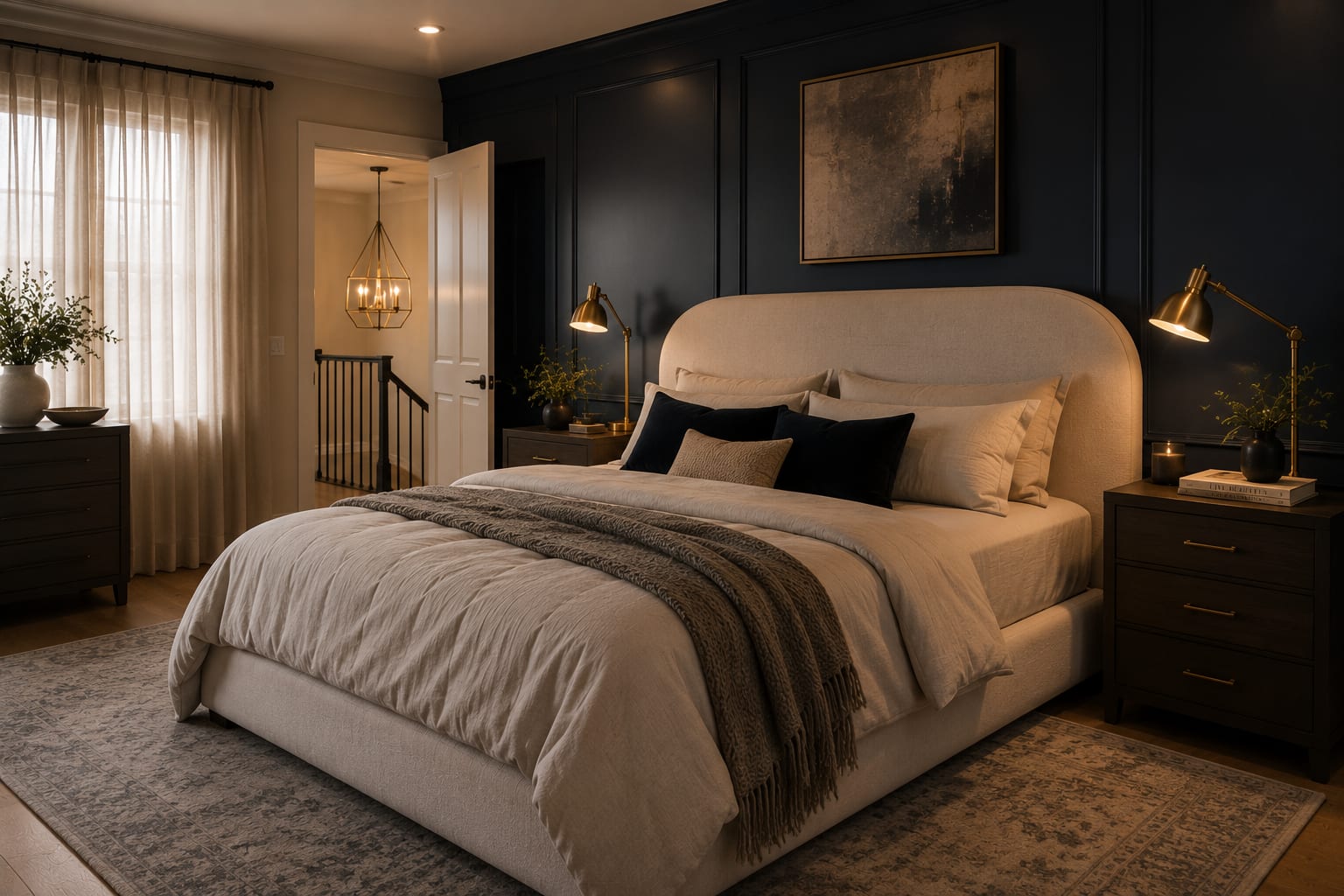
The formula underneath it is simple enough to copy: one colour, one metal, one stone. What changes room to room is how much of each you use, and where it sits.
1. The kitchen, where the navy earns its keep
 See the full design
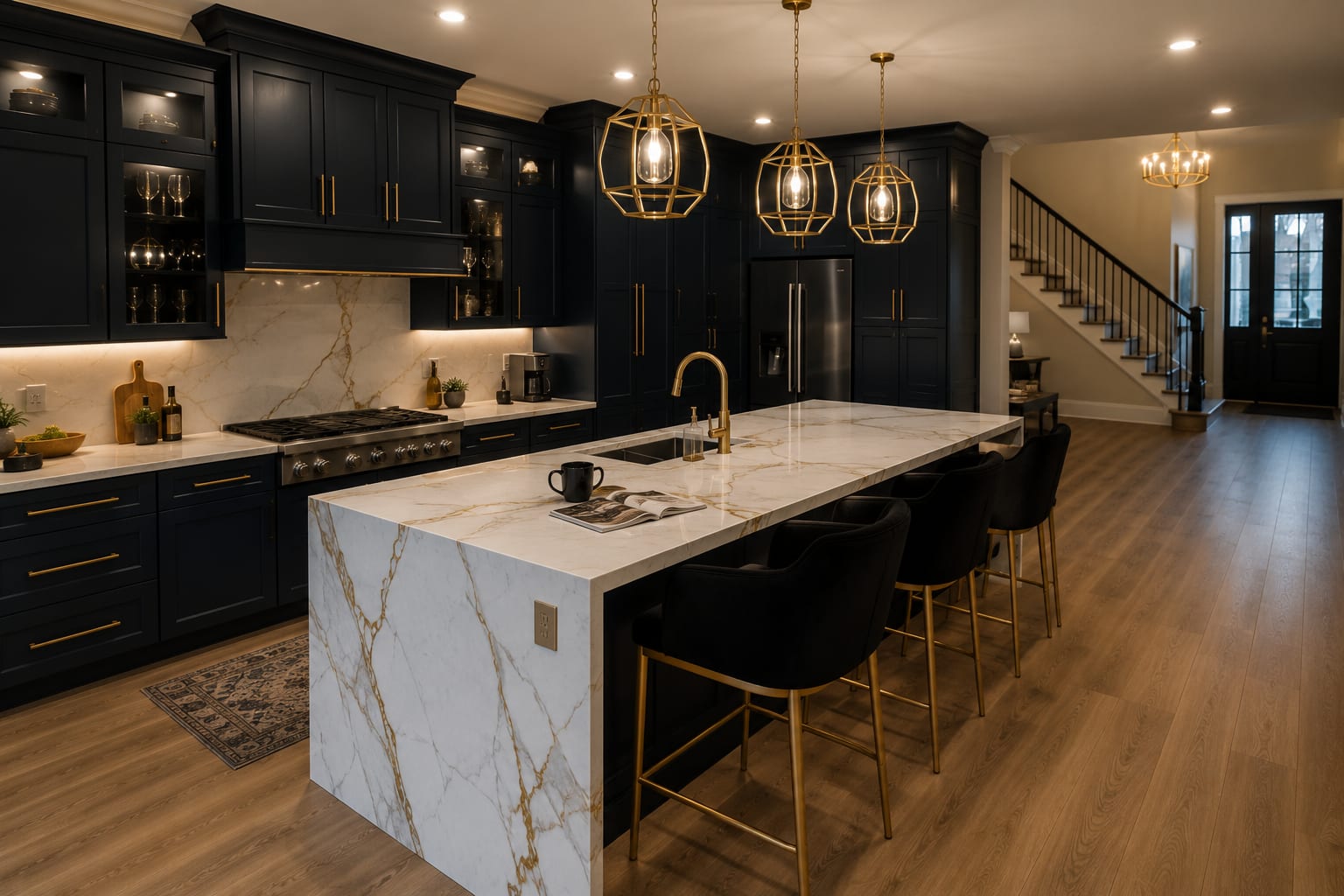
 Navy blue kitchen cabinets have become one of the most-installed dark finishes of the decade, and this is why: navy reads as a neutral from across the room and as a colour up close. Shaker fronts keep shadow in a large dark run, and the Calacatta waterfall island stops the room going heavy. Steal this: pick a navy with a grey undertone. Purple-leaning navies are the ones that date.
2. The living room, repeat the colour, change the material
 See the full design
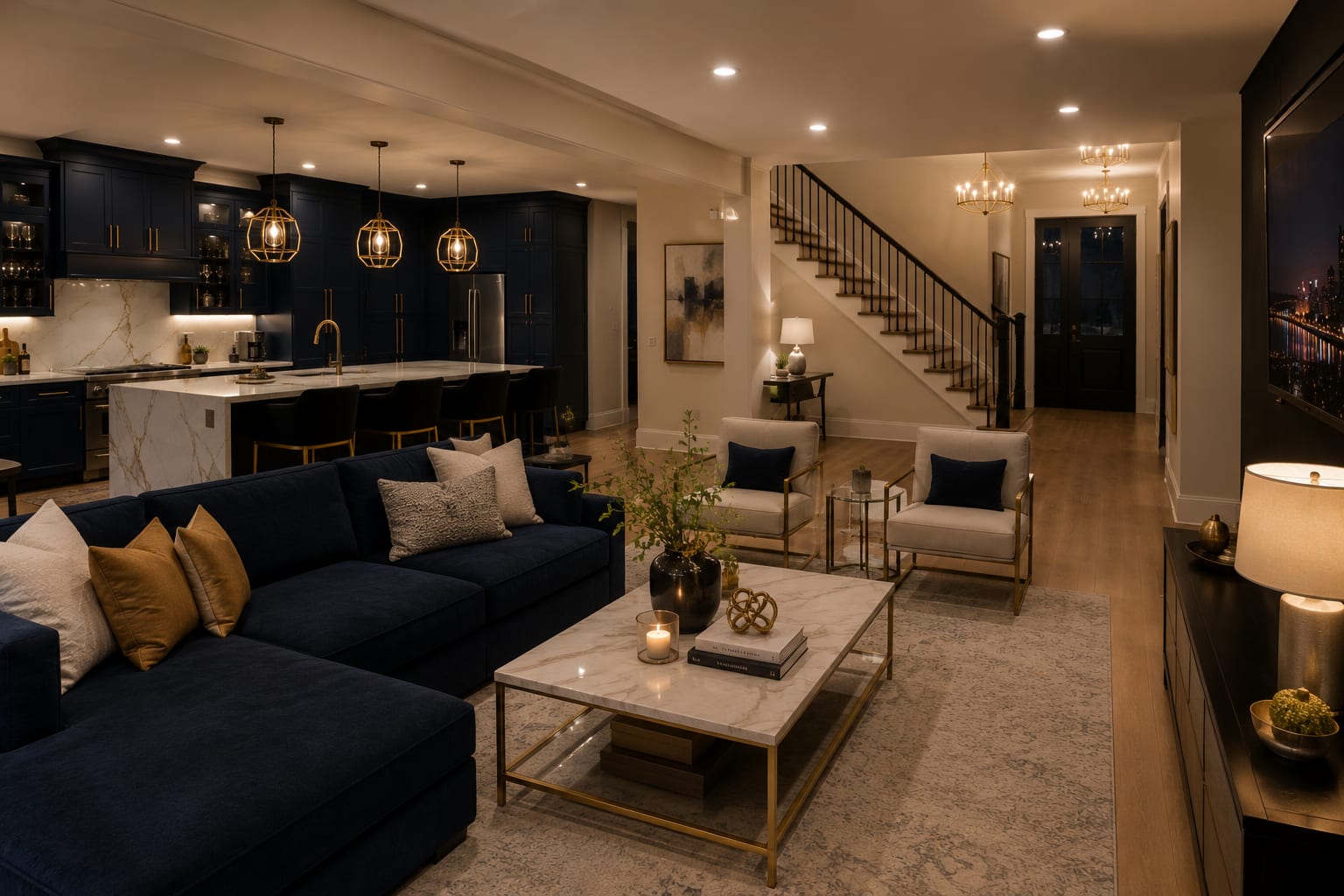
 The sectional is the same navy as the kitchen cabinets twenty feet away, but in velvet, not paint. That is the core move of a whole-house scheme: hold the colour, change the texture. Ochre cushions stop the blue going cold, and the open-legged brass chairs keep the sightline through to the kitchen clear. Steal this: in open plan, any colour must appear at least twice or it looks like one odd purchase.
3. The bedroom, one wall is the whole dose
 See the full design
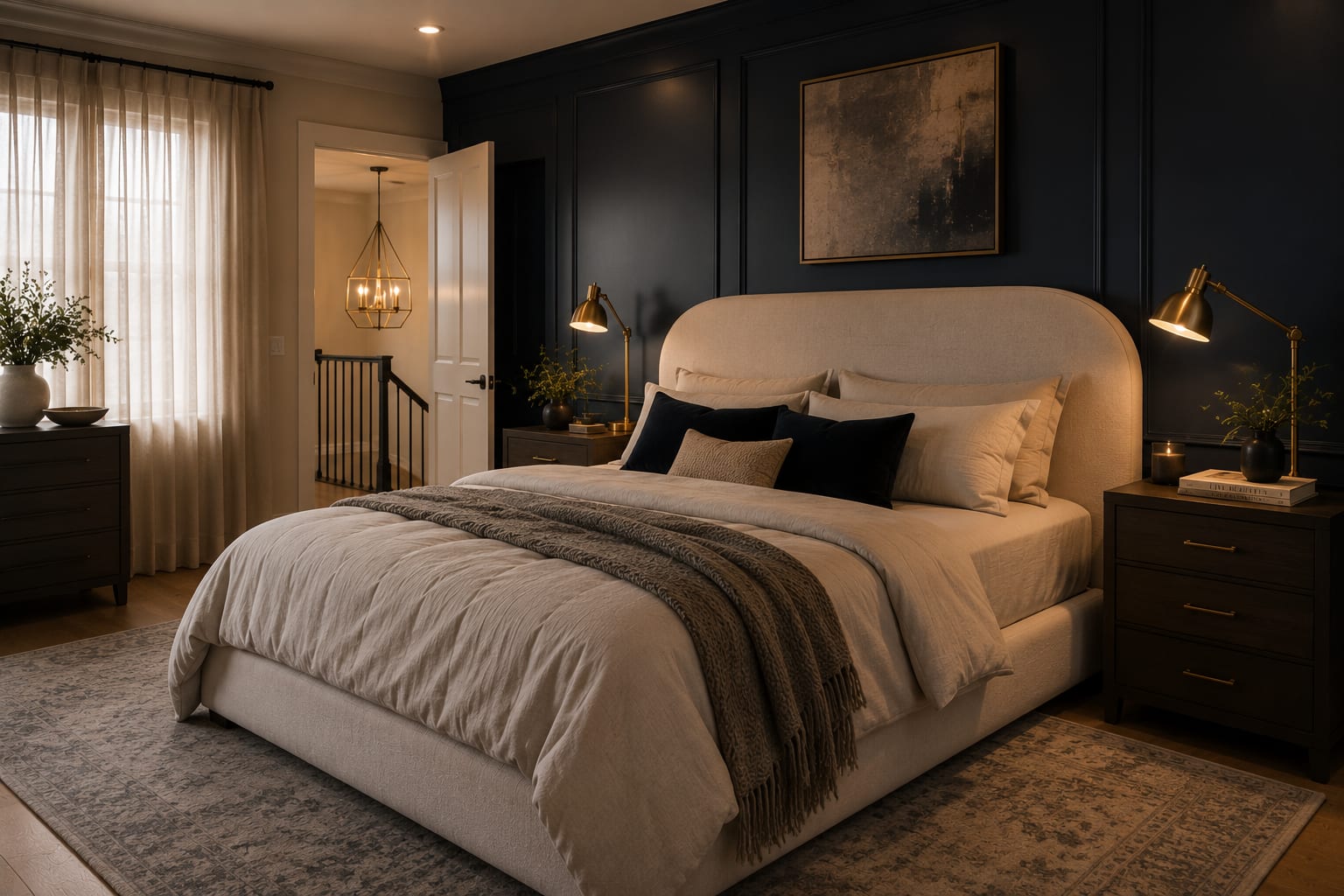
 Bedrooms are where people overdo a colour they love. Here navy appears on one wall only, the one you never look at while lying in bed, and everything in front of it is cream linen. The mouldings are painted the same navy so they read as shadow, not stripes. Steal this: if you want a dark bedroom wall, put it behind the bed and keep the other three pale. All the drama, none of the gloom.
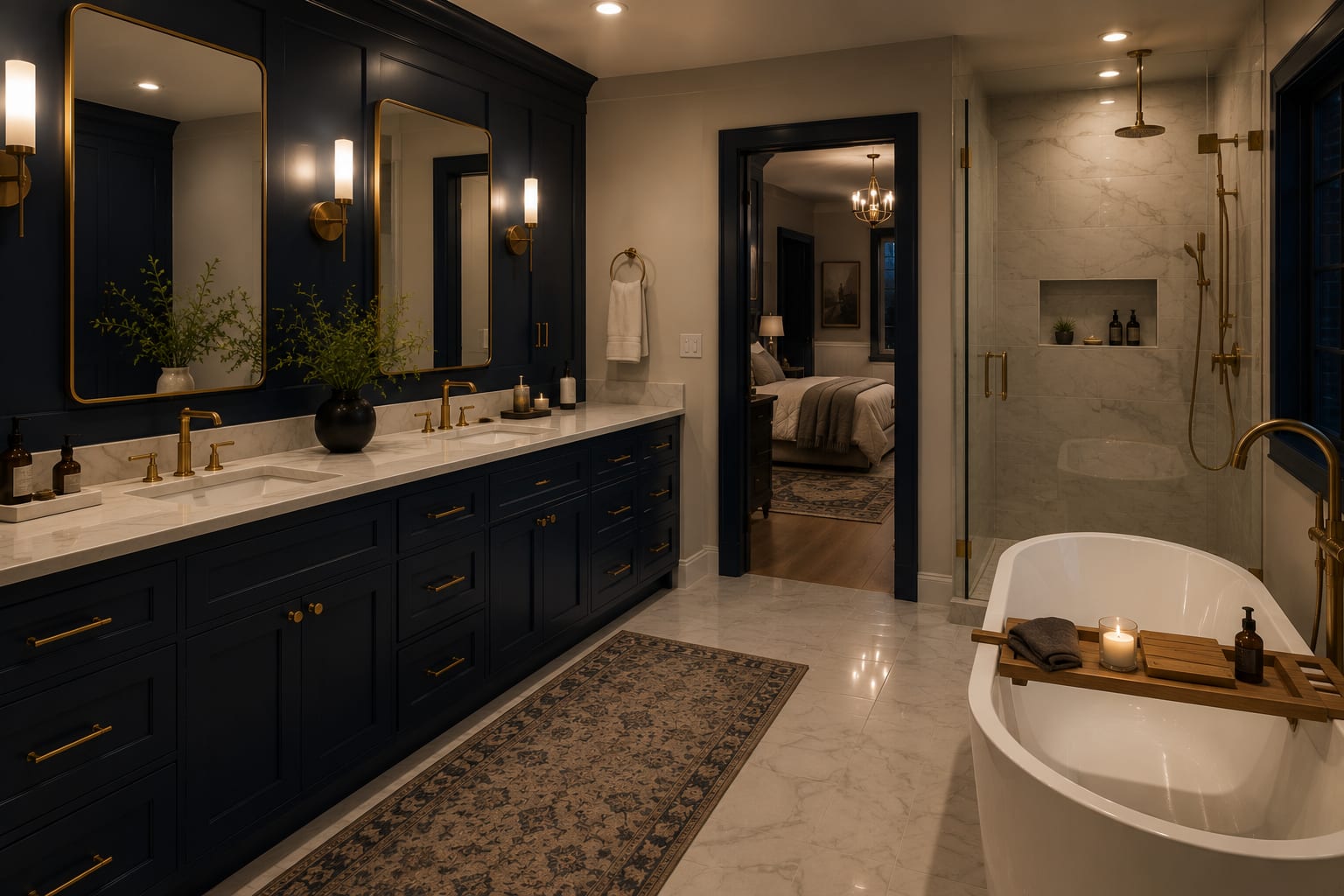
4. The ensuite, keep the dark below eye level
 See the full design
 This is where most whole-house schemes quietly give up and default to white tile. Carrying navy onto the vanity, while everything above stays pale marble, keeps the bathroom part of the house without making a small room feel like a cave. Steal this: in a bathroom, use one metal finish everywhere. Unlike a large room, you can see every fitting at once, so a mismatch is obvious.
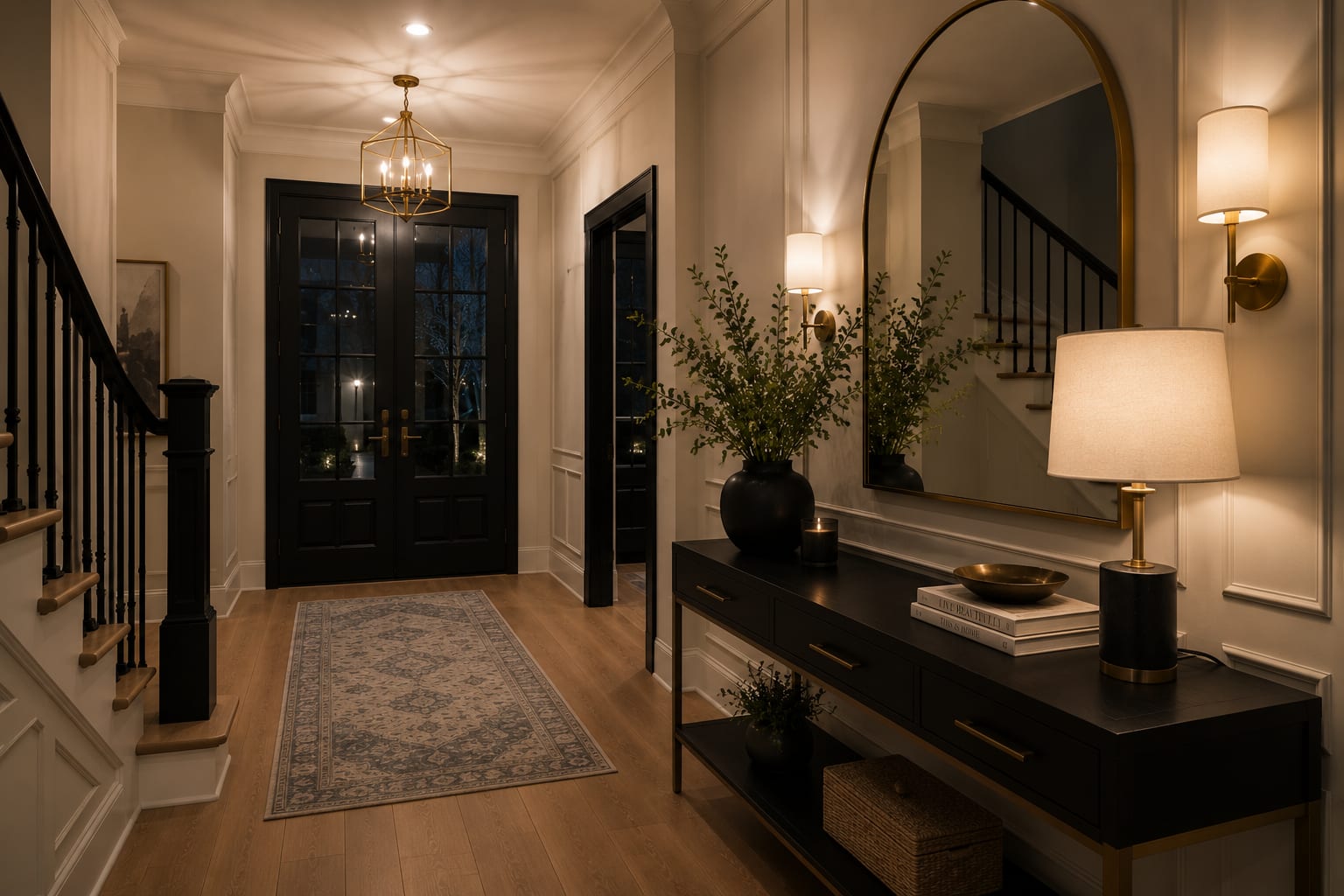
5. The entryway, preview the scheme, don't repeat it
 See the full design
 The entry does not use navy at all, it uses black, which is the same idea one step darker, plus the same brass. That is deliberate: an entry should set the expectation, not spoil the reveal. The oversized arched mirror is doing the heavy lifting, reflecting the glazed door back into a narrow space. Steal this: go one size bigger on a hall mirror than feels sensible. In a hallway it works like a window.
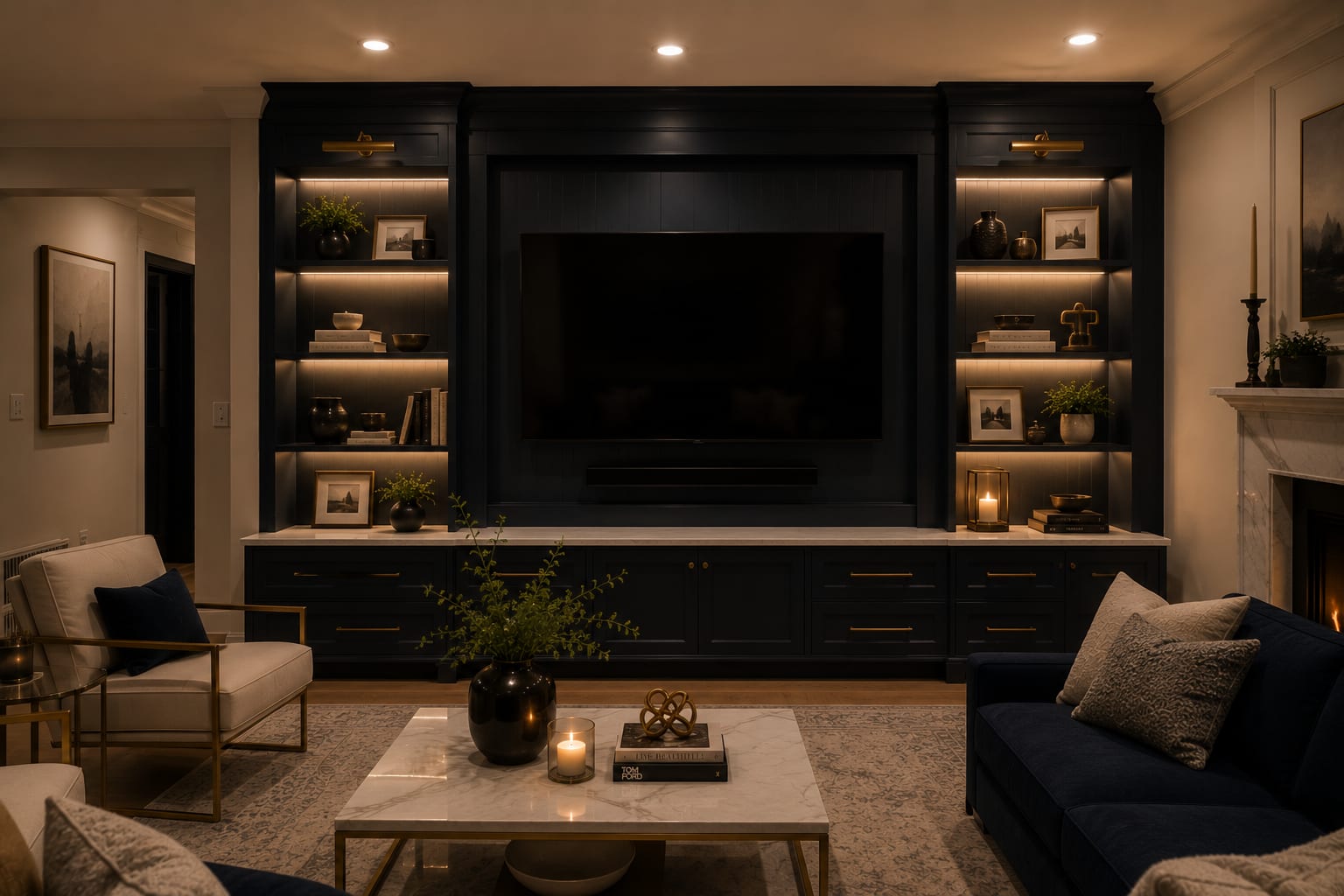
6. The media wall, where paint beats marble
 See the full design
 Painted joinery in the kitchen's navy costs a fraction of a stone media wall and does something stone cannot: it holds a serious amount of closed storage. The TV sits in a panelled recess so it reads as cabinetry, and brass picture lights above the shelves give it the presence a slab would have provided. Steal this: give the entire lower half to closed doors. That is the whole reason to choose joinery over stone.
The three rules that hold it together
- One colour, three intensities. Navy appears as full cabinetry (kitchen), as an accent wall (bedroom) and as a single piece of furniture (living room). Same colour, different dose, that is what stops repetition.
- One metal, no exceptions. Brass on every tap, handle, light and frame. Mixing metals across a house is the fastest way to make it feel decorated in phases.
- One stone, everywhere it appears. The same pale marble runs from the kitchen island to the bathroom vanity to the coffee table, so the eye keeps recognising it.
Where whole-house schemes usually go wrong
Two failures account for most of them. The first is using the colour at the same strength in every room, navy kitchen, navy bedroom walls, navy bathroom, navy living room, which stops feeling considered and starts feeling like there was only one tin of paint. Vary the dose. The second is abandoning the scheme in the rooms nobody photographs: the hallway, the utility, the guest bathroom. Those are exactly the transitions where a house either holds together or falls apart, because you pass through them between the rooms that matter.
If you are starting from scratch, work in this order: choose the metal first (it appears in every room and is the hardest to change later), then the stone, then the colour. Most people do it backwards, fall in love with a paint shade, and then spend the rest of the project trying to find fittings that do not fight it.
Join the conversation
Share your thoughts on this room