

warm grain, natural texture, practical drawers and flattering mirrors: what to compare before choosing a favourite
Use "An Oak Fluted Vanity with an Oval Backlit Mirror and Marble Wall" as a scale check. Identify the dominant surface, the secondary material and the lighting that connects them. If your room cannot preserve that hierarchy, simplify the idea before choosing finishes.
5 rooms, each with its own design decision
A Grey Fluted Vanity with an Organic Pebble Backlit Mirror
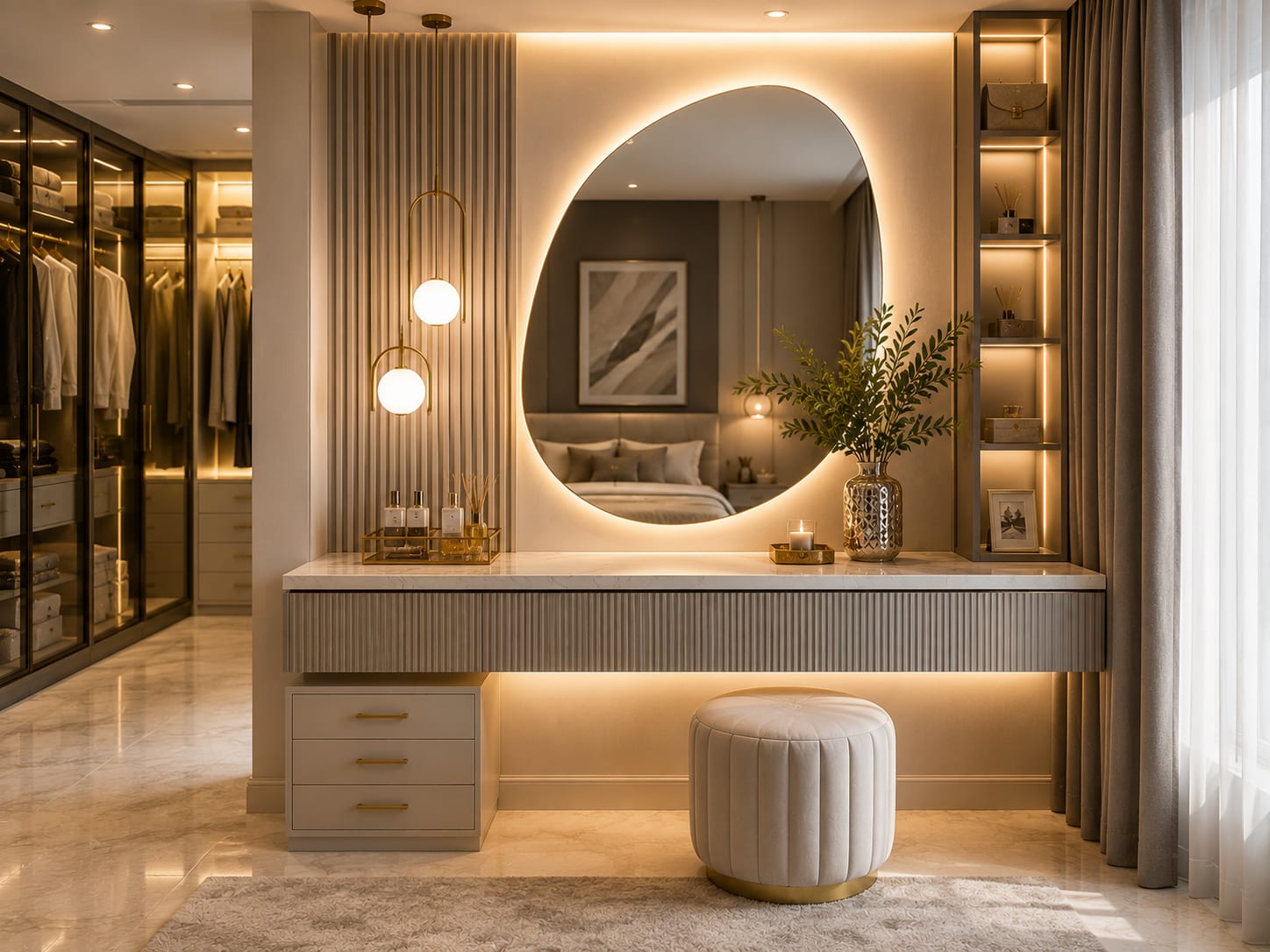
A grey fluted floating vanity with a marble top, a drawer base with gold pulls, an organic pebble-shaped backlit mirror, twin opal globe pendants, a fluted feature wall and lit display niches. The organic pebble-shaped backlit mirror is the standout, its soft irregular outline relaxes a room full of straight fluting, and the halo of light behind it is flattering and calm. A grey fluted floating vanity with a drawer base gives storage without bulk, twin opal globe pendants on brass read like soft moons to one side, and the fluted feature wall with cove light wraps the whole nook in warmth. Lit glass niches hold the perfume and bags. Key details: Choose an organic, pebble-shaped mirror to soften a scheme full of straight fluting. ; Halo-light the mirror and cove-light the fluted wall behind for a warm glow. ; Add a drawer base beside the floating section for real storage without bulk. ; Hang twin opal globe pendants to one side as a soft, sculptural light moment. ; Keep the palette grey, marble and gold, cool joinery, warm metal, bright top.. Yes, an organic or pebble-shaped mirror softens a room full of straight lines (fluting, drawers, panelling), which is exactly why it works over a fluted vanity. Practically, make sure it's still tall and wide enough to actually use, pick one where the widest part sits at face height. As a backlit version it doubles as ambient light, and the soft outline reads more current than a plain rectangle.
A Fluted Oak Floating Vanity with an Organic Backlit Mirror
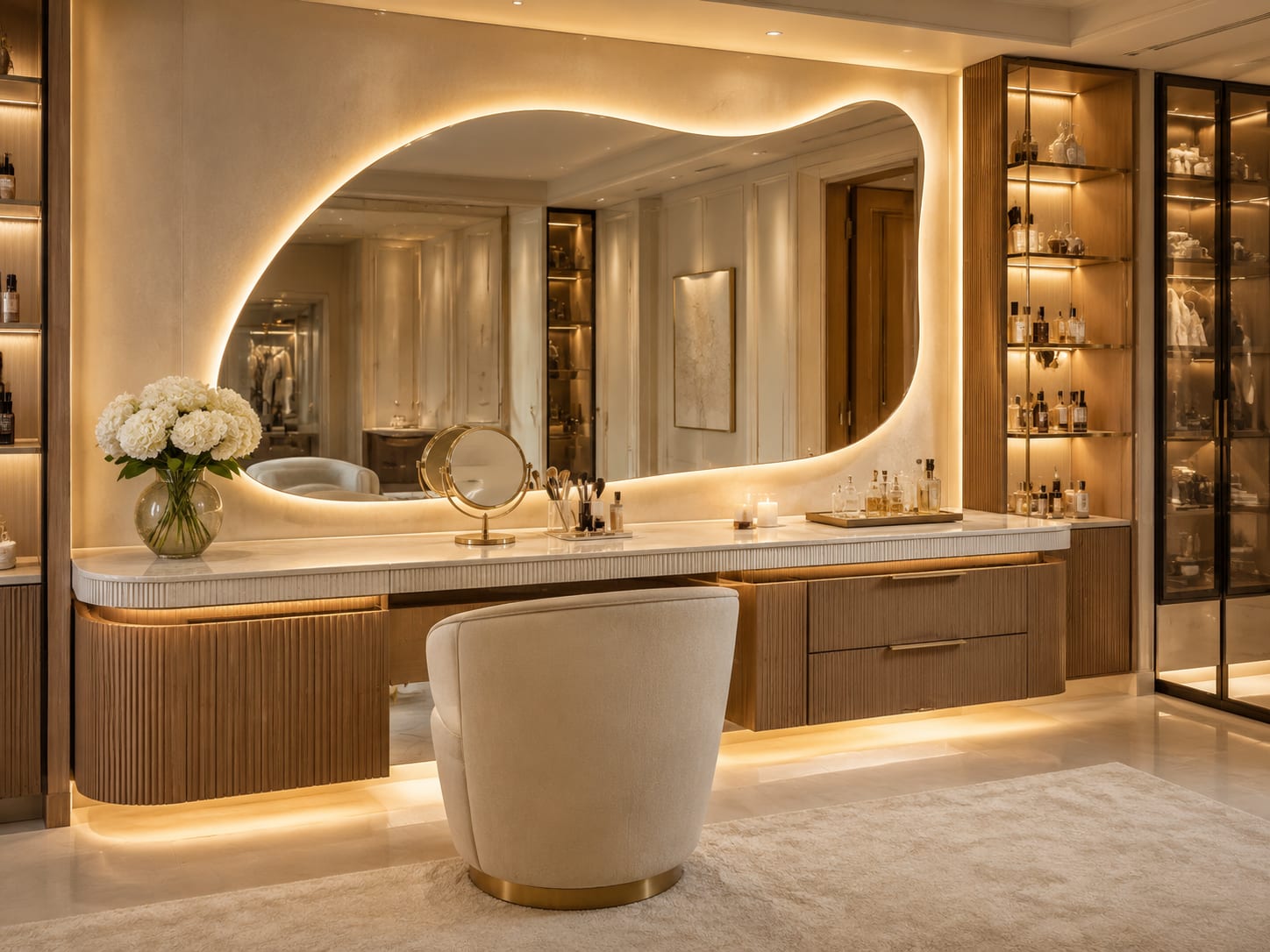
A wall-hung fluted oak vanity with a marble top, an organic wave-edged backlit mirror and lit glass-front cabinets holding perfume. It floats. A wall-hung vanity shows the floor running underneath, which is what keeps a big run of cabinetry from feeling heavy, and the LED strip tucked beneath it does the rest, it reads as a glow, not a fixture. The fluted oak adds vertical texture that catches the warm light in fine lines, and the marble top keeps the surface calm. Storage is honest: deep drawers plus lit glass-front cabinets for the perfume that would otherwise clutter the counter. Key details: Hang the vanity off the wall and hide an LED strip underneath, the float is the whole effect. ; Choose an organic, wave-edged mirror as the single sculptural piece; keep everything else rectilinear. ; Light the mirror from behind (backlit) rather than with a downlight, so the face is lit evenly. ; Use fluted fronts for texture, but keep the worktop plain stone so it doesn't get busy. ; Give perfume its own lit glass cabinet, on display but off the counter.. Backlit mirrors are flattering because the light wraps the whole face, but they are ambient light, not task light, the glow behind the glass doesn't put much light *on* your face for close work. Pair it with a small portable ring or puck light for detailed make-up, or add discreet side sconces. Also check the mirror is genuinely anti-fog and IP-rated if the vanity shares a wall with a bathroom.
An Oak Fluted Vanity with an Oval Backlit Mirror and Marble Wall
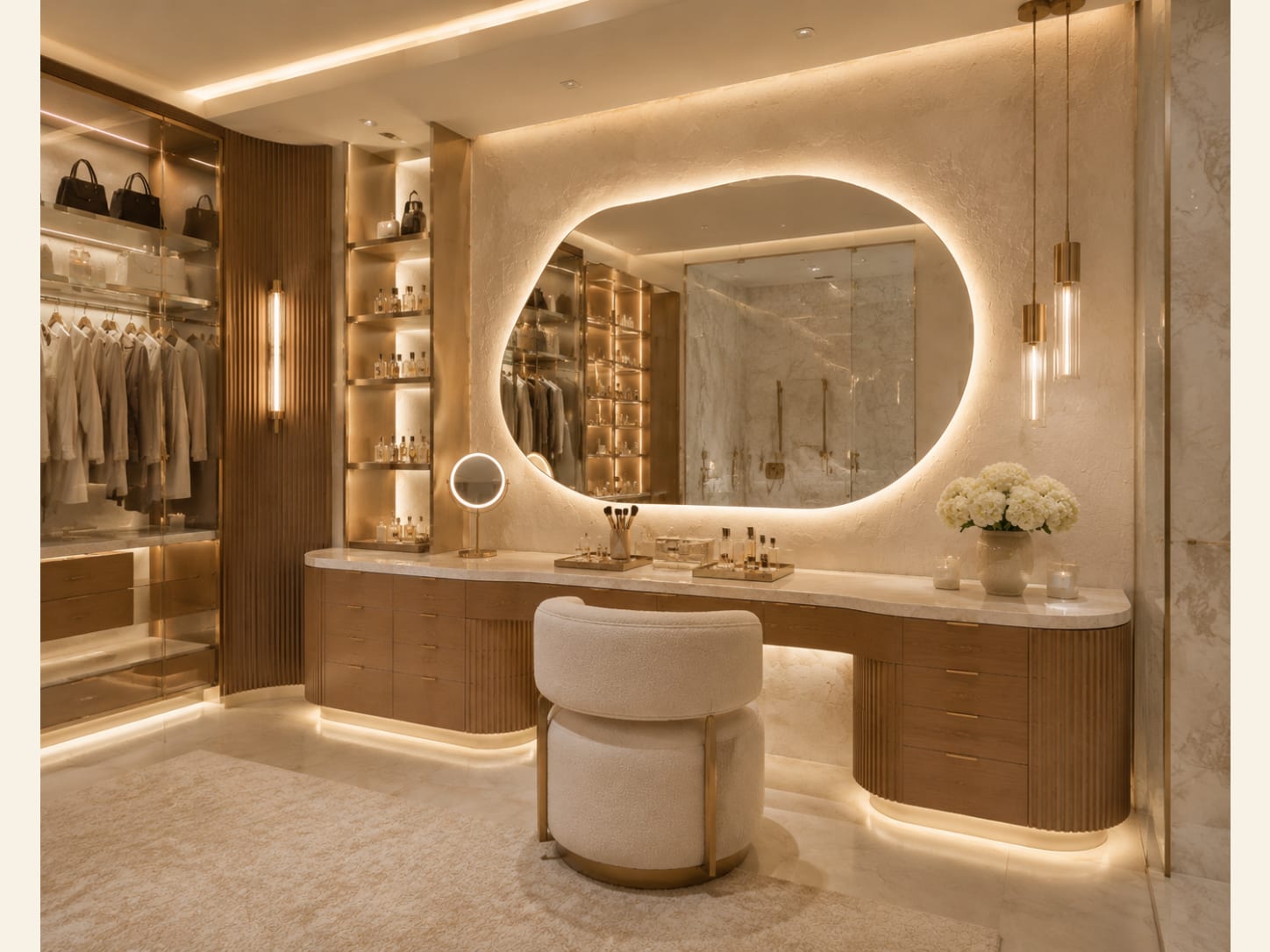
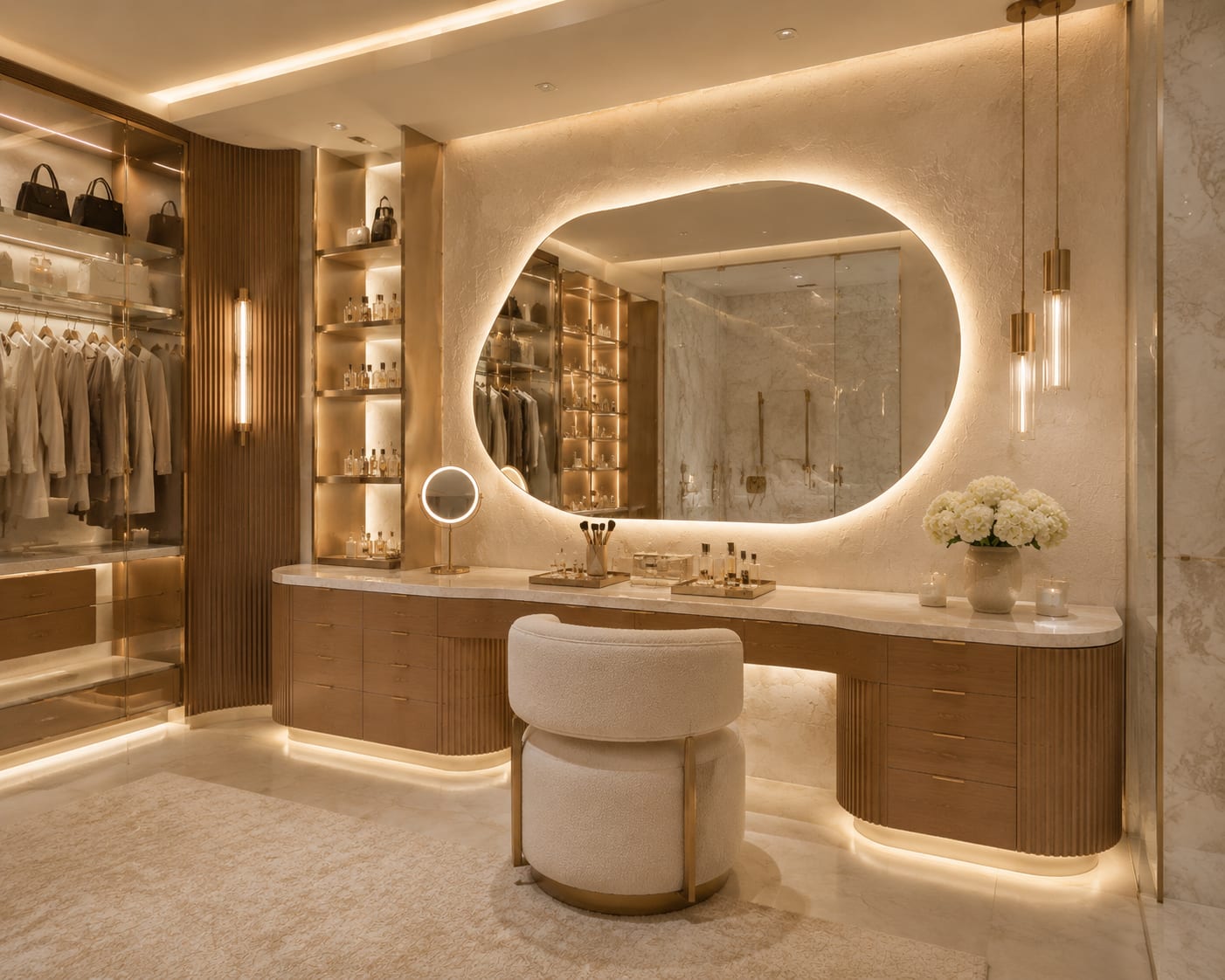
An oak fluted vanity with a marble top, a large oval backlit mirror on a plaster wall and lit glass shelving stocked with perfume and handbags. The oval softens a room full of straight cabinetry and mirrors your face more kindly than a rectangle. Setting it on a plaster panel rather than tile keeps the background quiet, and flanking it with lit glass shelving turns the whole wall into one composed unit, vanity below, mirror centre, display either side. The oak and marble keep it warm rather than clinical. Key details: Choose an oval or soft-edged mirror over a hard rectangle for a more flattering reflection. ; Set the mirror on a plain plaster panel so the glass shelving either side reads as the pattern. ; Match the backlight of the mirror to the shelf lighting, one warm temperature throughout. ; Balance cool marble with warm oak so the room doesn't feel cold. ; Keep the counter clear; let the lit shelves hold the bottles.. A rectangle maximises reflected area and suits a modern, architectural room; an oval or organic shape is softer and more flattering but reflects a little less. For a make-up vanity specifically, the oval's rounded top means light wraps the face more evenly and there are no hard corners at eye level. If the room is already full of straight lines, cabinets, shelves, doors, the curve is the piece that relaxes it.
A Sculptural Stone Waterfall Vanity with an Indoor Tree
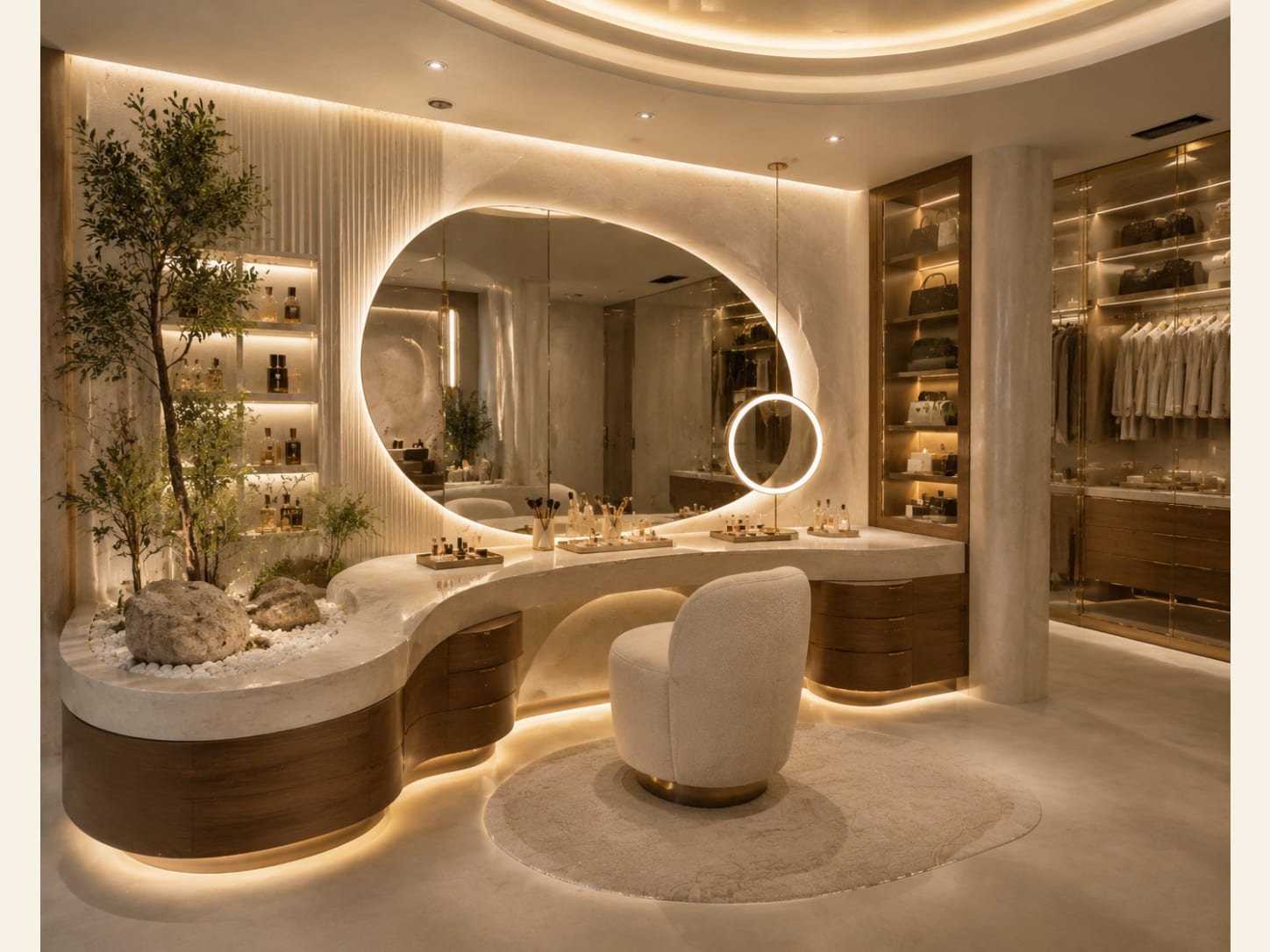
A curved stone waterfall vanity on a walnut base, with a huge organic backlit mirror, a round LED mirror, a boucle chair and a built-in indoor tree and rock garden. One continuous curved form, the stone flows from counter to a planted end without a straight line in sight, which is what makes it read as a designed object rather than furniture. The indoor tree and rock garden bring the biophilic, spa quality that stops all the stone feeling cold. Two mirrors do two jobs: the large organic backlit mirror for ambience, a round LED mirror for close work. Key details: Let one material (stone) flow in an unbroken curve from counter into the base or a planter. ; Add a real biophilic moment, a tree, a rock garden, to warm all the hard stone. ; Use two mirrors: a large ambient backlit one and a small round LED for detail. ; Set the stone on a warm walnut base so the palette doesn't go cold. ; Keep the floor and walls pale so the sculptural vanity is clearly the hero.. The honest bit: an indoor tree in a low-light dressing room is a commitment. Most trees that look this good, olive, ficus, want bright, indirect light, so this only works near a window or under a proper grow light. If the room is genuinely dark, use a high-quality faux tree (they have come a long way) rather than watching a real one slowly decline. Either way, plan the drainage or use a cache pot so watering never touches the stone.
An Oak Travertine Vanity with Glass Globe Pendants
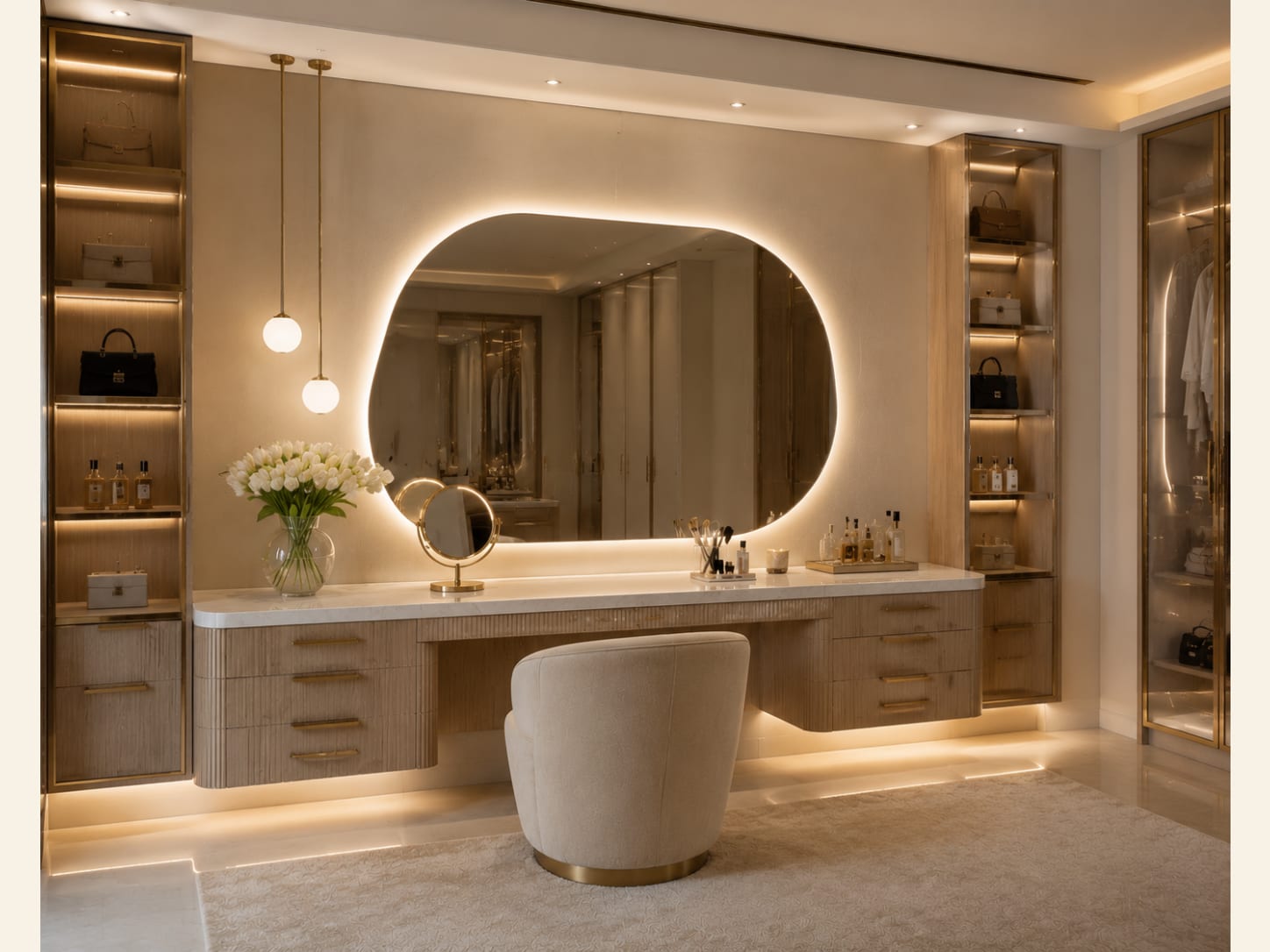
A fluted oak vanity with a travertine-look top, an oval backlit mirror, twin glass globe pendants, a boucle swivel chair and lit glass display shelving. The whole thing sits in a honey-and-cream band that feels genuinely warm. Twin glass globe pendants, hung low at the side, add a spark of light and stop the wide mirror wall feeling flat. The oval backlit mirror keeps it soft, and the lit glass shelving frames handbags and perfume as the display. Fluted oak gives the vertical texture that catches the light. Key details: Stay in a honey-and-cream palette for the warmest, most relaxed version of a vanity. ; Hang a pair of glass globe pendants low beside the mirror for a spark of light. ; Use a soft stone (travertine or a warm marble) rather than a cool grey top. ; Frame handbags and perfume in lit glass shelving as the display. ; Keep fluted oak fronts for texture against the smooth stone.. Pendants beside a vanity should sit just above eye level when seated, roughly 60–70 cm above the counter, so they light the space without glaring into the mirror or your eyes. Hang them to one side rather than dead-centre if the mirror is backlit, so the two light sources don't compete. And keep the bulbs warm and dimmable; a bright cool globe next to a soft mirror looks mismatched.
What to verify before recreating the look
For wood and organic vanity ideas, the practical decisions have to support warm grain, natural texture, practical drawers and flattering mirrors. A dressing table works best when the seat, knee space, drawers and mirror are planned together. Put flattering light on both sides of the face or use a well-diffused mirror, then add a separate task source if the surface doubles as a desk. Check socket placement for hair tools without leaving cables across the floor. Wall-mounted units and mirrors need fixings suited to the actual wall construction.
How to edit these wood and organic vanity ideas for a real room
Use “A Grey Fluted Vanity with an Organic Pebble Backlit Mirror” and “An Oak Travertine Vanity with Glass Globe Pendants” as two boundaries rather than a shopping list: identify which end better matches your room's scale, then keep the strongest idea connected to warm grain, natural texture, practical drawers and flattering mirrors. Resolve seated comfort, flattering face-level light, socket position and drawer access before adding decorative layers. The finished space should preserve the useful relationship you noticed in the reference while leaving room for the objects, habits and maintenance needs that make it yours.
Join the conversation
Share your thoughts on this room