

material-led media walls without unrelated room schemes: what to compare before choosing a favourite
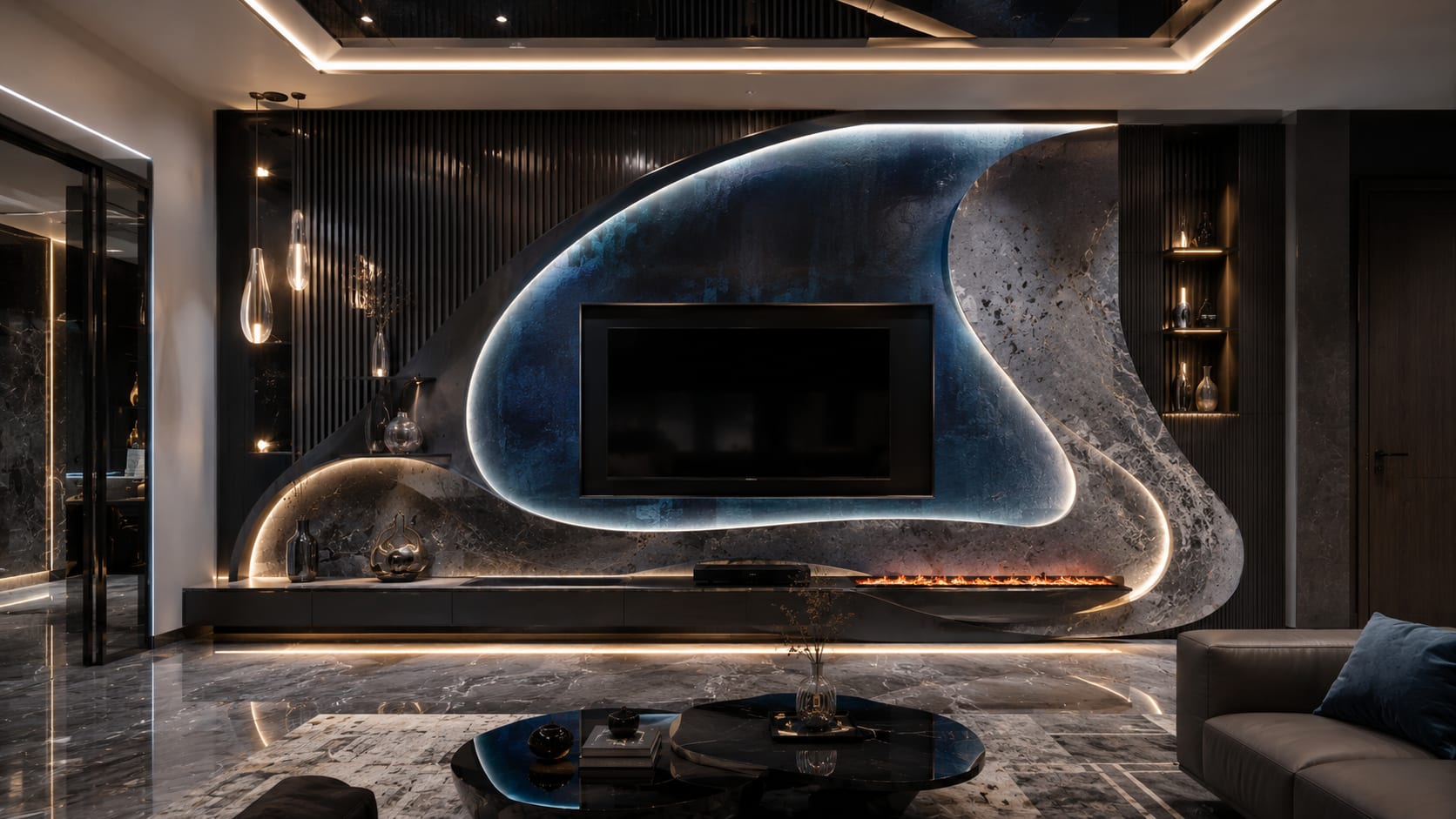
Start with the large shapes and the route through the room. The finishes in "A Sculptural Blue and Terrazzo TV Wall with a Linear Fire" make sense because their scale and lighting support one another; copying the colour without that relationship would produce a different result.
8 rooms, each with its own design decision
A Modern Backlit Stone TV Wall with Walnut Fluting
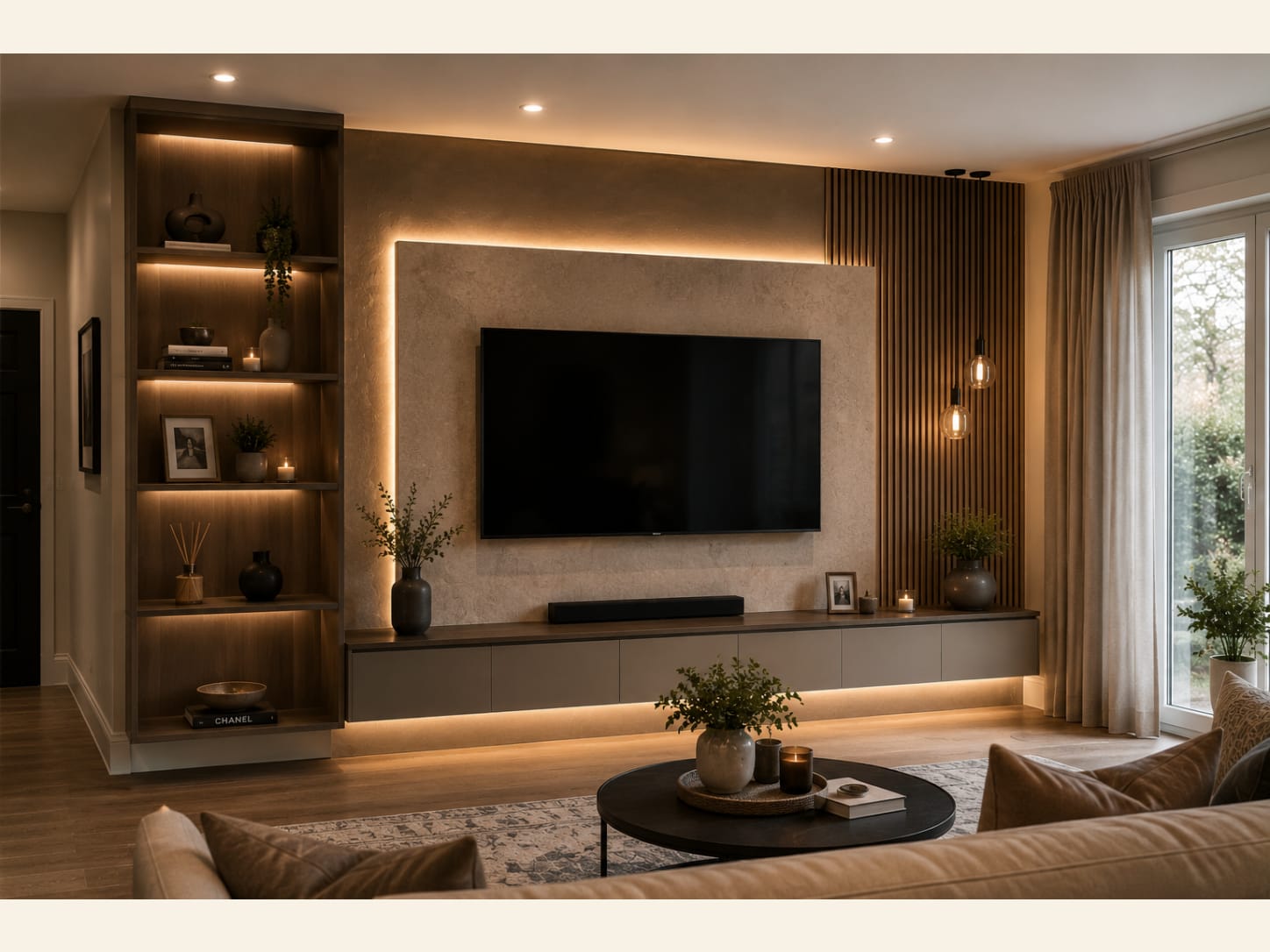
A modern living room with a backlit plaster-stone TV panel, a walnut fluted accent, a floating media console, lit walnut shelving, glass globe pendants and a tan leather sofa. A backlit plaster-stone panel sits the TV in a soft halo of warm light, and a band of walnut fluting to the side adds vertical texture and warmth. The floating media console with an LED strip beneath it looks like it hovers, which keeps the wall feeling light. Lit walnut shelving holds a small, edited display, and glass globe pendants by the window add a designer spark. The whole wall is warm-toned so the black screen recedes into it. Key details: Backlight a matte plaster or stone panel so the TV sits in a warm halo, not on a black void. ; Float the media console and hide an LED strip beneath it for a weightless look. ; Add a band of fluted wood beside the panel for texture without extra colour. ; Keep the shelved display small and lit, a few objects, not a full wall. ; Use warm 2700–3000K LED throughout so the whole wall reads warm.. For the screen itself, a matte backlit plaster or stone panel is best, it's tonally even, so the black rectangle sits quietly in the glow. Fluted wood is beautiful but its vertical lines run behind the screen and the eye keeps trying to follow them, so it works better as an accent *beside* the TV than directly behind it. This wall does exactly that: stone behind the screen, fluting to the side.
A Limestone Arch TV Wall with a Long Linear Fireplace
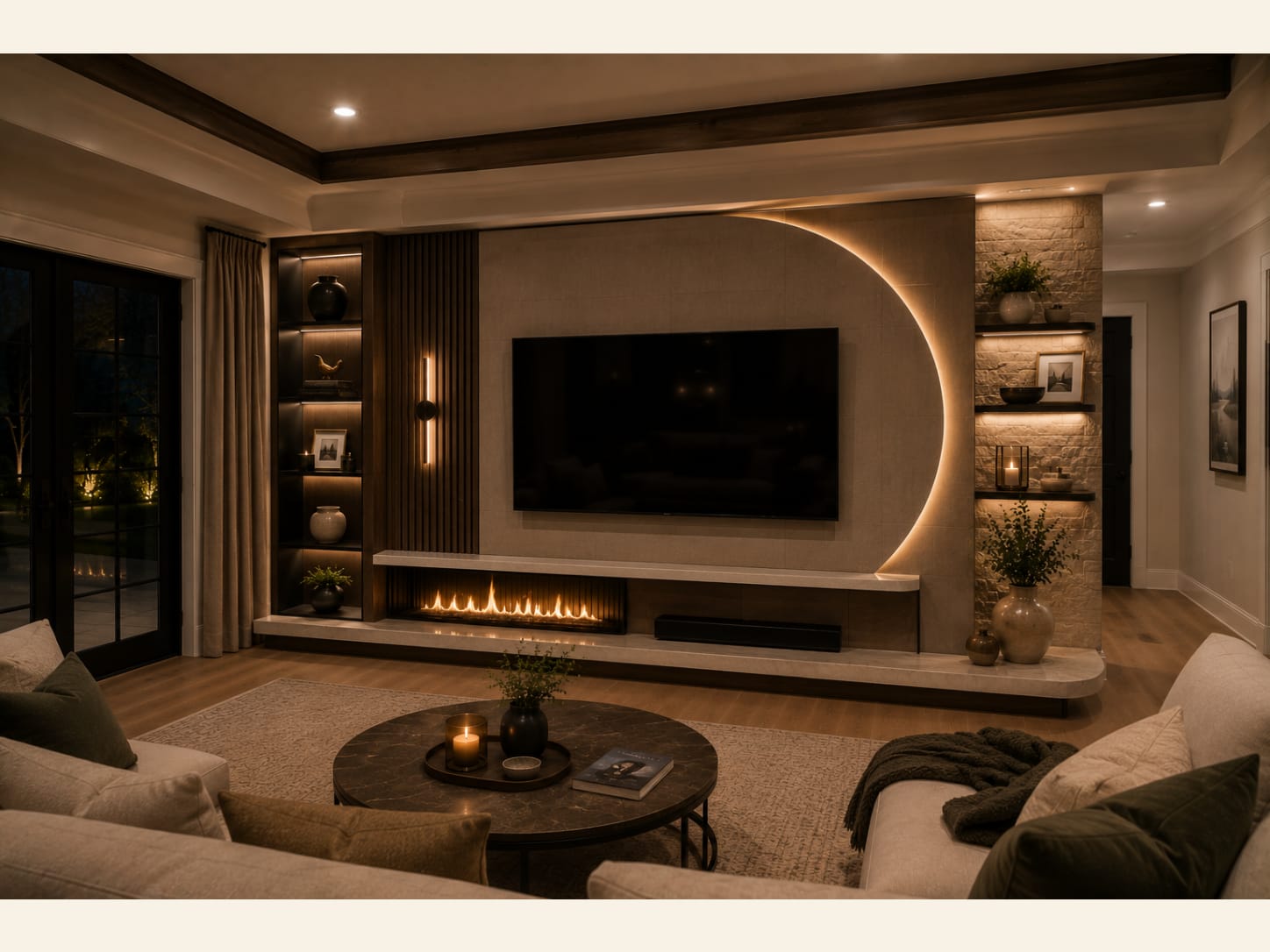
A backlit arch cut into warm limestone frames the screen above a long linear fire set on a raised stone hearth, with fluted timber one side and a rough stone-block column the other. The arch is backlit rather than outlined in a hard line, so the light bleeds softly onto the limestone and the shape reads as a glow instead of a neon edge, a much warmer effect than the crisp LED curves elsewhere. Limestone is the right stone for it because its matte, slightly chalky surface diffuses light instead of reflecting it. The linear fireplace sits on a raised hearth that projects into the room, which does two useful things: it gives the fire a real base rather than a slot in a cabinet, and it creates a ledge that grounds the whole composition. Flanking materials are deliberately different, fluted dark timber on one side, a rough stone-block column on the other, so the wall feels collected rather than showroom-symmetrical. Key details: Backlit limestone arch, a large half-round recess glowing softly behind the screen; Long linear fireplace, a wide ribbon flame set into a raised stone hearth; Raised stone hearth, a projecting plinth that grounds the wall and gives a ledge; Fluted timber panel, dark vertical battens with a slim lit sconce on the left; Rough stone-block column, textured stone with floating shelves closing the right side; Beamed ceiling, dark timber beams that echo the warm palette overhead. Practical moves: Recess the arch slightly and light it from within so the glow is diffuse, not a hard outline.
A Textured Limestone Plaster TV Wall with Oak Slats

A softly textured beige plaster panel glows behind the screen, framed by warm oak slats, a tall walnut bookshelf and a handleless taupe console lit from beneath. The texture is the luxury here. A limestone-effect plaster panel has a subtle, slightly cloudy surface that changes through the day, and because the LED sits behind the panel rather than around a recess, the light spreads as a soft halo instead of a defined line. That softness is what makes the wall feel domestic rather than commercial. The oak slat panel to the right carries the warmth across and gives the eye rhythm, while the tall walnut bookshelf on the left adds real, useful storage and stops the wall being purely decorative. Everything at low level is handleless and taupe, which keeps the base quiet and lets the textured panel hold attention. It is warm, layered and, importantly, buildable by a normal joiner. Key details: Textured limestone plaster panel, a soft beige feature panel with a mottled finish; Backlit halo, LED behind the panel casting a diffuse glow onto the wall around it; Warm oak slat panel, vertical battens closing the right-hand side of the composition; Tall walnut bookshelf, a full-height lit shelving unit for books and objects; Handleless taupe console, a floating unit with push-to-open fronts and under-glow; Warm bulb pendants, small exposed-filament lights adding a domestic, lived-in note. Practical moves: Build the panel proud of the wall on battens and hide the LED behind its edges for a halo.
A White Marble TV Wall Framed by Backlit Oak Fluting

A bright white marble panel is banded above and below by warm oak fluted slats lit from behind, with dark charcoal side panels, a walnut display column and a stone-topped console. Sandwiching the stone between two horizontal bands of fluted oak does something clever: it caps the marble at a comfortable height instead of letting it run to the ceiling, which keeps the wall from feeling top-heavy in a normal-height room. Both bands are lit from behind, so at night you read two warm horizontal lines with the cool white stone floating between them, genuine warm-and-cool balance rather than one dominating. The charcoal side panels are doing quiet structural work, framing the bright centre and stopping the marble from bleeding into the wall. To the left, a walnut lit column adds vertical relief, and the console's white stone top with dark fronts repeats the same light-over-dark logic as the wall above. Key details: White marble panel, a bright, softly veined stone plane centred behind the screen; Backlit oak fluted bands, warm ribbed timber above and below the stone, lit from behind; Charcoal side panels, dark flanking sections framing the bright centre; Walnut lit display column, a tall shelving tower on the left with warm strips; Stone-topped console, a floating unit with a white stone top and dark drawer fronts; Floor-level cove, warm LED beneath the console lifting the whole run. Practical moves: Cap the marble with the fluted band at around door-head height so the wall stays balanced. ; Backlight both bands equally, an uneven pair immediately looks like a mistake.
A Sculptural Blue and Terrazzo TV Wall with a Linear Fire

A sweeping organic form in oxidised blue metal and grey terrazzo, traced by one continuous ribbon of light, with a long linear fireplace set into the base curve. The discipline is in the single light line. One continuous LED follows the entire curve without a break or a joint, and that unbroken stroke is what makes a complicated shape read as one confident gesture instead of a collection of parts. The material change happens along the curve rather than at a straight seam, so the blue and the terrazzo appear to flow into each other. Oxidised blue metal is an unusual choice and a smart one: it is dark enough to keep the screen readable but has enough iridescence to catch light and avoid looking flat. Setting the fire into the lower curve rather than in a straight box keeps the sculpture intact, the flame becomes part of the shape, not an appliance stuck underneath it. Key details: Oxidised blue metal panel, a deep patinated blue surface forming the upper sweep; Grey terrazzo stone, speckled aggregate stone flowing along the lower part of the curve; Continuous LED ribbon, one unbroken line of light tracing the full length of the form; Linear fireplace, a long flame bed set into the base of the curve, flush with the console; Black fluted panelling, vertical ribbed backdrop that lets the sculpture stand forward; Glass teardrop pendants, hand-blown lights that repeat the organic language overhead.
A Warm Marble and Fluted Walnut TV Wall with Brass Inlay

A backlit cream marble panel framed by fluted walnut columns, slim brass inlay lines and lit display niches, with a floating walnut console that runs the full width of the wall. The success here is proportion, not expense. The marble panel is deliberately narrow, barely wider than the TV, so the screen sits inside a frame instead of floating on a huge slab. Everything either side is fluted walnut, which breaks up what would otherwise be a flat expanse and throws soft vertical shadows all day. Slim brass reveals trace the joints between wood and stone, and because they are thin they read as tailoring rather than bling. The console floats, lit from underneath, so the whole composition looks lighter than its materials suggest. The trick worth stealing: warm the marble from behind with concealed LED, and the veining stops looking like a printed surface and starts looking like depth. Key details: Backlit cream marble panel, a book-matched slab lit from behind the edges so the veining glows; Fluted walnut columns, full-height vertical grooved timber flanking the stone; Slim brass inlay, hairline metal reveals where wood meets marble and along the console; Lit display niches, walnut recesses with pale stone shelves and warm concealed strips; Floating walnut console, a full-width media unit with under-cove lighting and brass edge; Slatted wood ceiling, a timber ceiling raft with cove lighting that mirrors the wall below. Practical moves: Size the stone panel to the TV plus roughly 40–50 cm each side, resist covering the whole wall.
A Symmetrical Calacatta TV Wall with a Linear Fireplace

A perfectly mirrored media wall in book-matched Calacatta marble with gold inlay lines, dark fluted columns, tall lit shelving and a long ribbon fireplace set into the console. Two decisions carry the whole design. First, the marble is book-matched, two slabs mirrored down the centre line so the veining opens like a butterfly directly behind the TV. That is what makes the stone look composed instead of accidental. Second, the linear fireplace sits below the screen, not beside it, which solves the classic living-room argument about where to look: both focal points stack on one axis. Vertical gold inlay lines repeat at even intervals across the stone, quietly reinforcing the symmetry, and the fluted dark columns at each end stop the pale marble from bleeding into the walls. The lit shelving towers are identical on both sides, styled with similar object weights, get that balance wrong and the symmetry collapses. Key details: Book-matched Calacatta marble, mirrored slabs with the veining opening behind the screen; Linear ribbon fireplace, a long, low flame bed set into the top of the media console; Vertical gold inlay, evenly spaced slim brass strips running the height of the stone; Dark fluted columns, grooved timber uprights bookending the marble panel; Tall lit shelving towers, matching display units either side with warm concealed strips; Fluted media console, a long ribbed dark-wood unit spanning the full wall width. Practical moves: Ask your stone supplier specifically for book-matched slabs and approve the layout before cutting.
A Warm Walnut Fluted TV Wall with a Cream Marble Panel
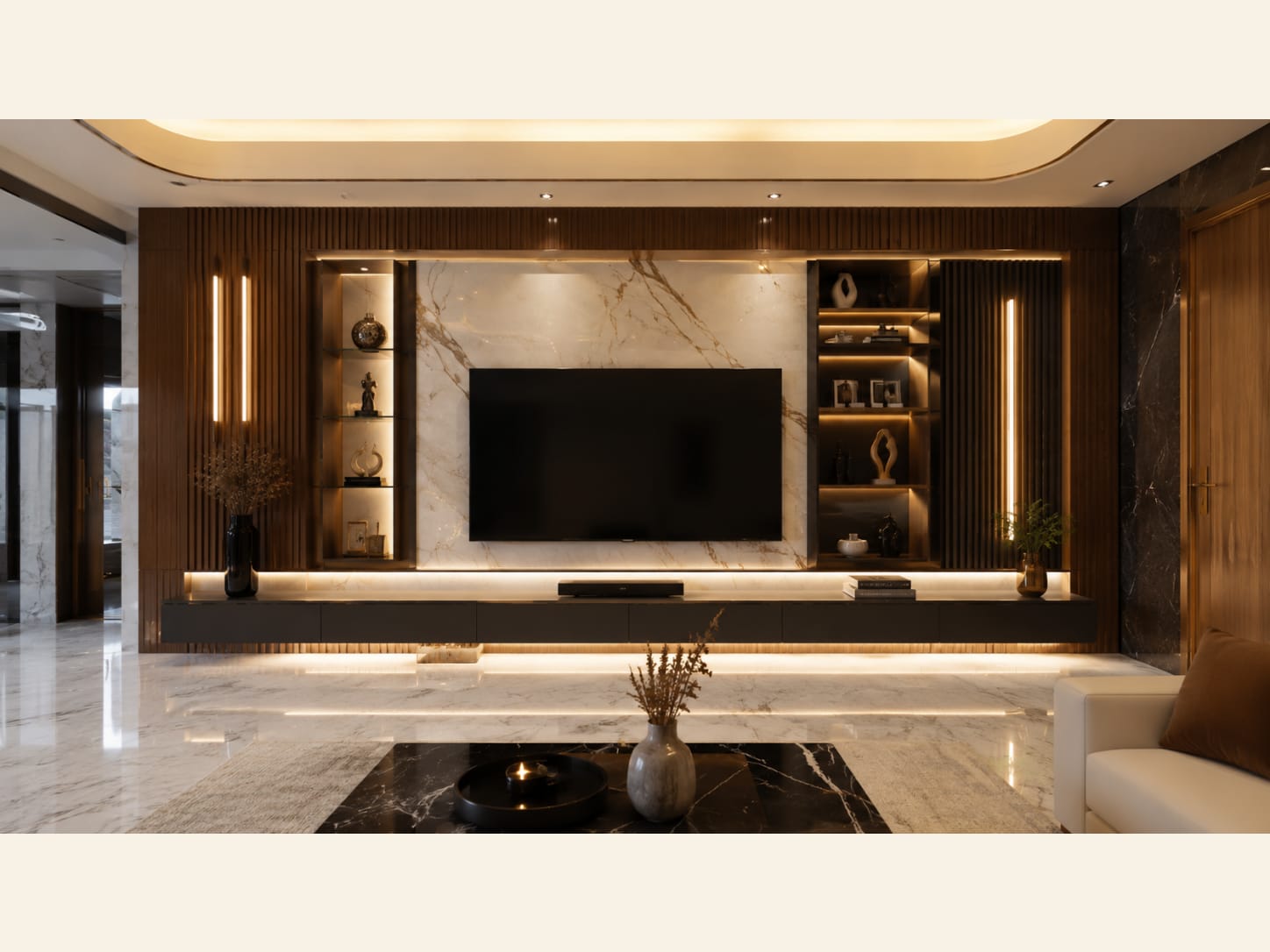
Full-height fluted walnut wraps the whole wall, with a cream gold-veined marble panel behind the screen, symmetrical lit niches, slim vertical light bars and a dark floating console. Wood-dominant walls feel calmer because timber absorbs light instead of bouncing it. Running the fluting full height and full width turns the whole surface into soft vertical rhythm, and the eye stops looking for edges. The cream marble panel is framed like artwork rather than used as a backdrop, so a relatively small, and therefore affordable, piece of stone does all the visual work. The niches are symmetrical but not identical: glass shelves on one side, solid timber on the other, which keeps the balance from feeling mechanical. Two slim vertical light bars are set into the fluting itself, adding height and a modern edge that stops the walnut reading as traditional. Underneath, the console is dark and recessive, letting the wood and stone hold the attention. Key details: Full-height fluted walnut, vertical grooved timber covering the entire wall surface; Framed cream marble panel, a gold-veined stone inset sized closely around the screen; Symmetrical lit niches, display recesses with warm strips, glass shelves one side, timber the other; Vertical LED light bars, slim recessed strips set into the fluting for height and contrast; Dark floating console, a low, quiet media unit with concealed lighting beneath; Cove-lit ceiling, a curved ceiling reveal with warm light echoing the wall's glow. Practical moves: Run the fluting floor to ceiling without a break, a dado line or stopped panel ruins the effect.
What to verify before recreating the look
For wood, marble and stone tv wall ideas, the practical decisions have to support material-led media walls without unrelated room schemes. Plan screen height, viewing distance, ventilation, sockets, data points and speaker locations before building the decorative wall. Keep service panels and drivers accessible, use diffusers over LED strips and confirm the wall can support the television and any stone or cabinetry. Highly polished surfaces can reflect the screen and windows, so inspect samples from the actual seating position. Conceal cables through a compliant route rather than trapping adapters inside an unventilated void.
How to edit these wood, marble and stone tv wall ideas for a real room
Use “A Modern Backlit Stone TV Wall with Walnut Fluting” and “A Warm Walnut Fluted TV Wall with a Cream Marble Panel” as two boundaries rather than a shopping list: identify which end better matches your room's scale, then keep the strongest idea connected to material-led media walls without unrelated room schemes. Resolve screen height, viewing distance, ventilation, cable access and reflected glare before adding decorative layers. The finished space should preserve the useful relationship you noticed in the reference while leaving room for the objects, habits and maintenance needs that make it yours.
Join the conversation
Share your thoughts on this room