

garden views, timber and restful natural colour: what to compare before choosing a favourite
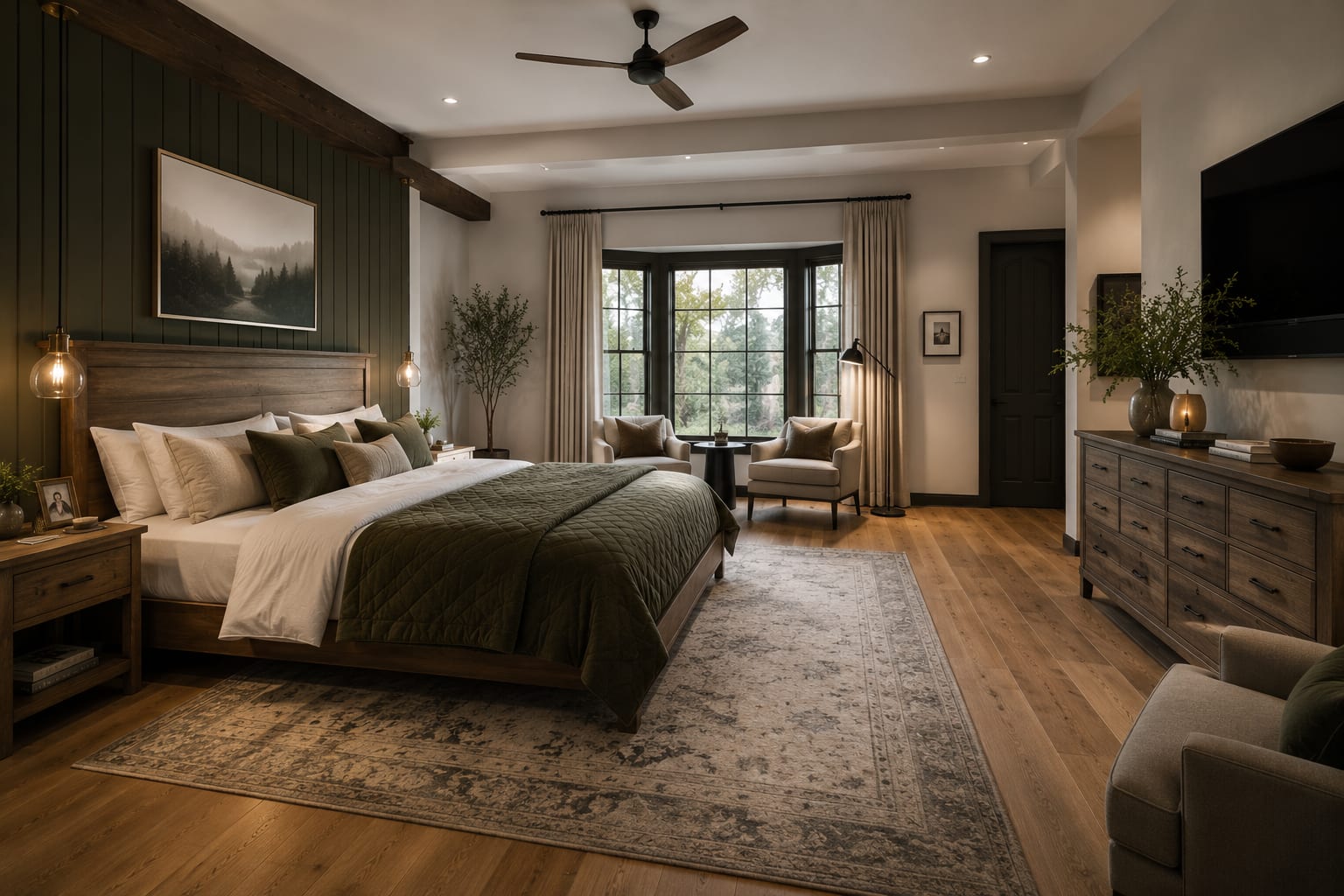
Use "A Forest Green Shiplap Bedroom with a Reclaimed Wood Bed" as a scale check. Identify the dominant surface, the secondary material and the lighting that connects them. If your room cannot preserve that hierarchy, simplify the idea before choosing finishes.
5 rooms, each with its own design decision
A Bright Cream Master Bedroom with a Garden Balcony and Lit Niches

A bright cream master bedroom with a wall-mounted TV, French doors to a garden balcony, lit built-in niches with abstract art, a cream upholstered bed, two armchairs and a bench. It's all soft cream and warm light, so it feels restful and expensive at once. Lit built-in niches flanking the headboard add depth and a spot for art and objects, the French doors to a garden balcony flood it with daylight, and a two-chair seating zone turns the bedroom into a suite. A wall-mounted TV keeps the surfaces clear. Key details: Keep the palette soft cream and let warm light do the work. ; Flank the bed with lit built-in niches for depth and display. ; Make the most of any window or balcony, daylight is the best luxury. ; Add two armchairs to create a seating zone and make it a suite. ; Wall-mount the TV and float the console so surfaces stay clear.. Use warm neutrals and warm light, not stark white and cool bulbs. Cream, oatmeal and soft beige with 2700–3000K lighting read cosy; bright white walls with cool light read clinical. Layer in texture, a chunky throw, a wool rug, an upholstered headboard, and a bright bedroom feels calm and enveloping rather than sterile.
A Whitewashed Shiplap Bedroom with Blue Linen and Jute

A whitewashed shiplap wall behind soft blue linen bedding, with woven rattan pendants instead of lamps, a reclaimed wood bench and a jute rug over wide oak boards. The shiplap is whitewashed rather than painted, so the grain still reads through, that texture is what stops a white wall behind a white-ish bed from going flat. Running the boards horizontally widens the wall, which suits a bed that already sits low. The bedding is the second decision: washed blue linen with cream and greige layers, no pattern anywhere, letting the crumple of the linen do the work. And the rattan pendants replace bedside lamps entirely, which frees both nightstands and adds the woven texture the room needs. Underfoot, a jute rug over washed oak keeps the whole thing grounded and slightly rough, so it never tips into hotel-smooth. Key details: Whitewashed shiplap wall, horizontal boards with the grain showing through the finish; Washed blue linen bedding, soft blue layered over cream and greige, no pattern; Woven rattan pendants, hung either side in place of table lamps; Reclaimed wood bench, a rough timber bench at the foot of the bed; Jute rug, natural fibre laid over wide washed-oak boards; Sheer white curtains, full-height panels diffusing the light; Washed oak nightstands, simple drawers with dark knobs. Practical moves: Whitewash the shiplap rather than painting it solid, you want to still see the grain. ; Run boards horizontally behind the bed; vertical boards make a low bed look lower. ; Buy linen bedding a shade lighter than you think, it darkens once washed and layered.
A Forest Green Shiplap Bedroom with a Reclaimed Wood Bed

Deep green vertical shiplap and an exposed beam behind a reclaimed-wood plank bed, with olive quilted bedding, glass globe pendants and a bay-window seating nook. Vertical shiplap in a deep forest green is doing most of the work. Painted boards give texture that flat paint cannot, and running them vertically lifts the ceiling, useful in a room with a heavy exposed beam overhead. Against that green, the reclaimed-wood plank headboard reads warm rather than orange, which is the usual problem with rustic timber against white walls. The olive quilted bedding sits in the same colour family as the wall, so the bed blends instead of competing, and the crisp white sheets underneath keep it from going murky. Then the bay window nook, two chairs and a small table, quietly turns a bedroom into somewhere you actually sit, which is what stops a rustic scheme feeling like a guest room in a lodge. Key details: Forest green vertical shiplap, painted board panelling behind the bed; Exposed timber beam, a dark structural beam crossing the ceiling; Reclaimed-wood plank bed, a chunky timber frame with a solid plank headboard; Olive quilted bedding, tonal layers over crisp white sheeting; Glass globe pendants, clear bulbs hung either side in place of lamps; Bay window seating nook, two armchairs and a side table in the window; Faded persian-style rug, muted pattern over wide-plank oak flooring. Practical moves: Run the shiplap vertically, not horizontally, it lifts a ceiling that a beam is already lowering. ; Choose a deep, slightly grey green; bright greens make timber look orange.
A Bright Minimalist Bedroom with a Nature View
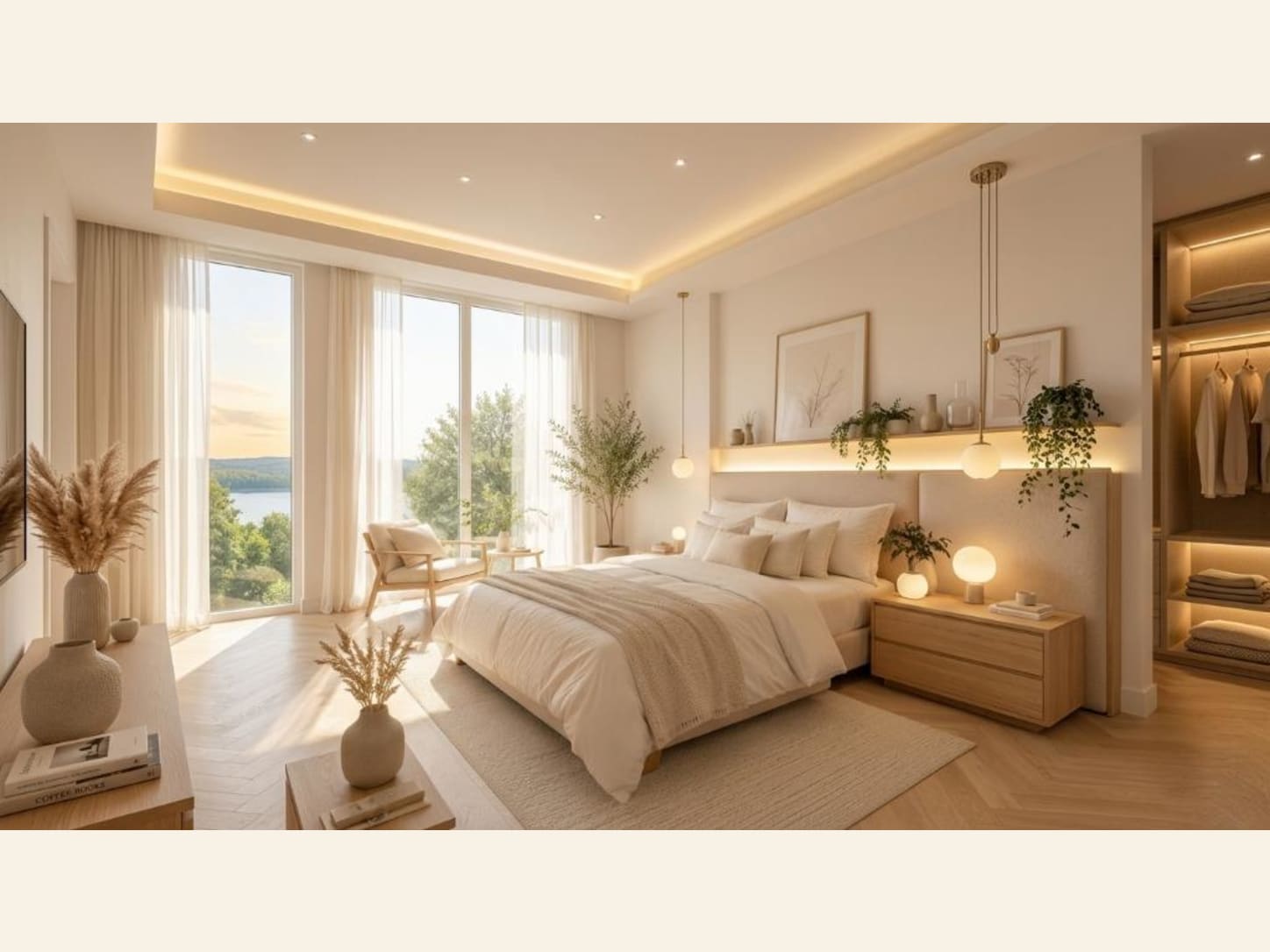
A bright, airy minimalist bedroom in warm white and light oak, with a calm lake view, soft cove lighting, globe lamps, and a serene Scandinavian feel. This room proves minimalist does not have to mean cold. Everything stays in a warm, light palette, white walls, oak floors, natural linen, so the big windows and the view do the decorating. A soft cove glow and round globe lamps keep the light gentle, and a few plants and pampas stems add just enough life. It feels calm, expensive and effortless all at once. Key details: Upholstered bed with layered linen bedding; Light oak herringbone wood floor; Floating shelf with art and trailing plants; Round globe pendant + globe table lamps; Floor-to-ceiling windows with sheer curtains; Open, warm-lit wardrobe. Practical moves: Keep everything in a warm, light palette, white walls, oak wood and natural linen. ; Let the big windows and the view be the main feature; use light, sheer curtains. ; Add a soft glowing strip in the ceiling plus round globe lamps for a gentle glow. ; Choose a light wood floor (oak or oak-look) and add a soft neutral rug under the bed. ; Add a couple of plants and some dried pampas stems for life, nothing more..
A Cozy Green Bedroom with a Swing Chair and Vanity Nook
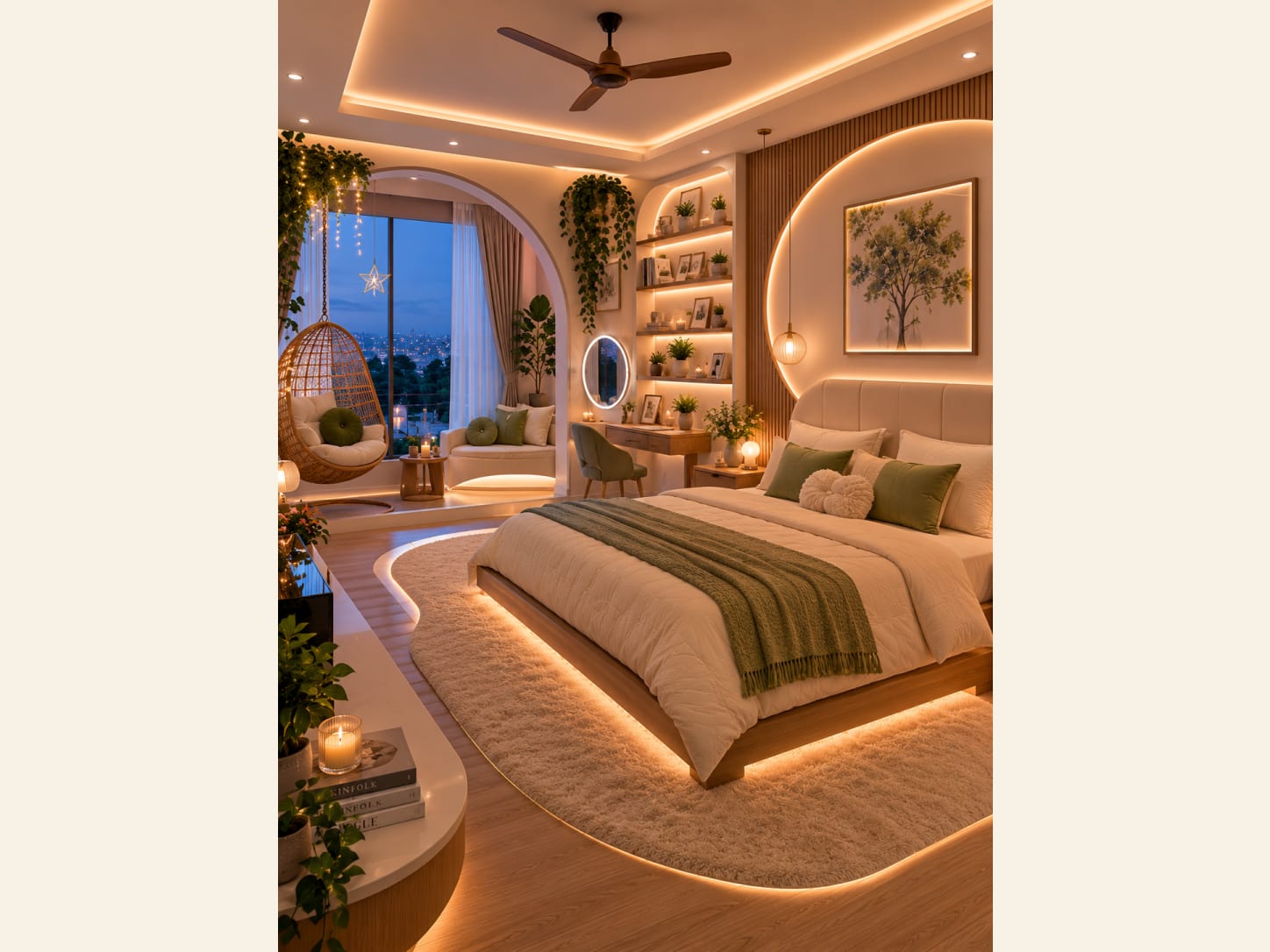
A cozy biophilic bedroom with green accents, a hanging rattan swing chair, an arched city-view window, a backlit vanity nook, lit plant shelves, botanical art and a curved floating bed. This room is calm, green and very liveable. Soft green accents and plants everywhere make it feel fresh and restful, while warm cove lighting and an under-bed glow keep it cosy at night. A hanging swing chair by the arched window adds a relaxing spot to unwind, and a tucked-in vanity nook with a backlit mirror means the room works hard without feeling cluttered. Curves and warm wood soften the whole thing. Key details: Hanging rattan swing chair by an arched window; Backlit vanity nook with a round mirror; Lit floating shelves full of plants; Curved backlit accent wall with botanical art; Curved floating bed with under-bed LED glow; Green throw, candles and a soft shag rug. Practical moves: Add soft green accents, bedding, a throw and lots of plants, for a fresh, restful feel. ; Hang a rattan swing chair near the window for a cosy relaxing spot. ; Build a small vanity nook with a round backlit mirror. ; Use lit floating shelves to show off plants, books and decor. ; Float the bed on a curved platform and light it from below. ; Finish with warm lamps, candles and a soft shag rug for a snug mood..
What to verify before recreating the look
For nature-inspired bedroom retreat ideas, the practical decisions have to support garden views, timber and restful natural colour. Begin with the bed position and a clear route to the door, wardrobe and window. Test headboard, bedside and desk dimensions with tape before ordering. Layer ambient, task and bedside lighting on separate controls, use lined window treatments where sleep needs stronger light control, and keep decorative wiring away from bedding and walking routes. A visualization can make a room appear wider than it is, so judge every feature against the measured wall rather than the camera angle.
How to edit these nature-inspired bedroom retreat ideas for a real room
Use “A Bright Cream Master Bedroom with a Garden Balcony and Lit Niches” and “A Cozy Green Bedroom with a Swing Chair and Vanity Nook” as two boundaries rather than a shopping list: identify which end better matches your room's scale, then keep the strongest idea connected to garden views, timber and restful natural colour. Resolve bed position, wardrobe access, bedside clearance and controllable light before adding decorative layers. The finished space should preserve the useful relationship you noticed in the reference while leaving room for the objects, habits and maintenance needs that make it yours.
Join the conversation
Share your thoughts on this room